EasyBit is a non-custodial instant crypto exchange built for people who want to swap assets without opening a trading account or learning a conventional exchange interface. It sits in the same broad category as ChangeNOW, SimpleSwap and Exolix, but its pitch is more direct: select two assets, choose a floating or fixed quote, send funds and receive the destination coin. That simplicity is real. The question is whether the convenience is worth the price and the lighter level of accountability that comes with a no-account swap service.
The site is clean, quick to understand and considerably less cluttered than many instant exchangers. You don't have to deposit into a personal balance, configure order types or wait for a manual withdrawal review before every trade. For a straightforward BTC to ETH or USDT to SOL conversion, that can be a relief. EasyBit is trying to serve a specific job rather than become a complete trading venue, and the product makes more sense once you judge it on those terms.
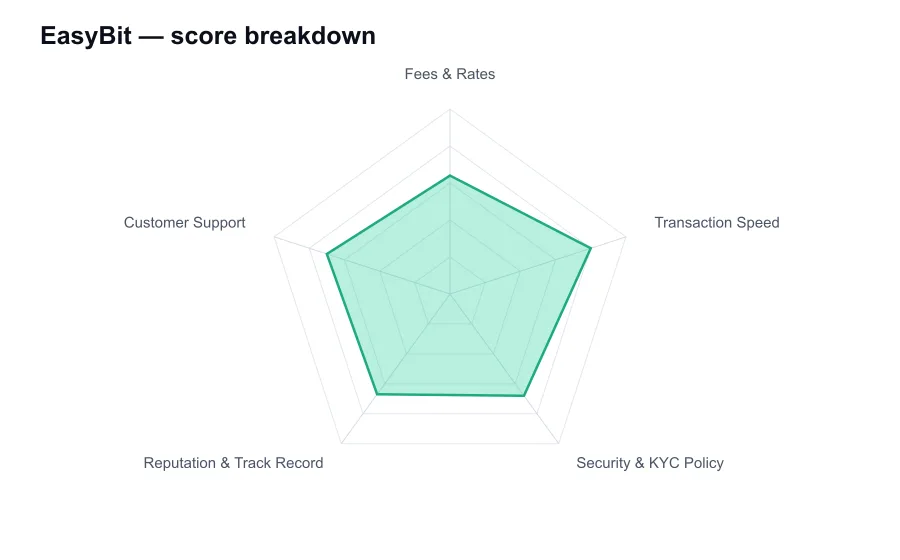
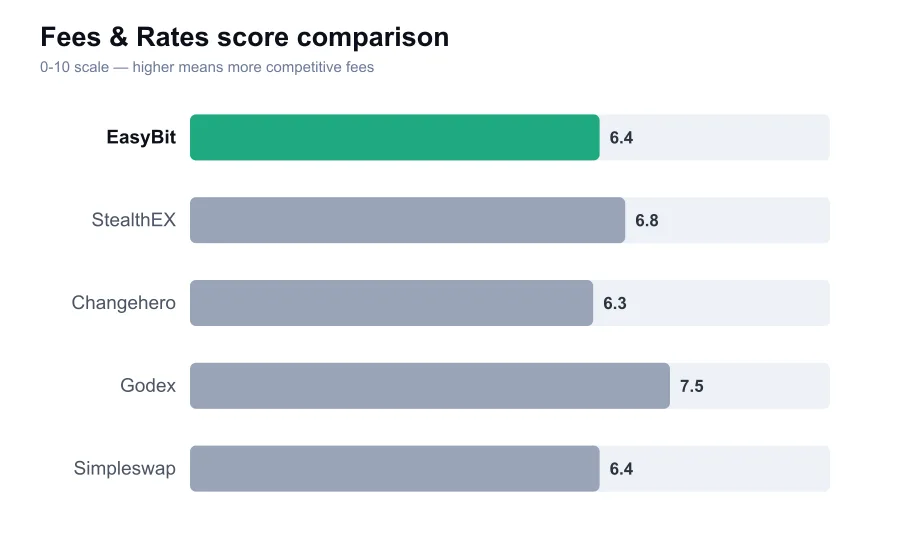
The main fee issue is not a visible ticket charge. Like most services in this class, EasyBit builds its compensation into the exchange quote, alongside network fees and the liquidity cost of sourcing the trade. Its floating-rate option has generally been presented as the cheaper route, while fixed-rate transactions cost more because EasyBit assumes the risk of market movement between quote creation and execution. This isn't deceptive by itself, but users should stop treating the displayed rate as the spot-market rate.
A quote can look perfectly reasonable until you compare the final expected output with a major exchange's mid-market price. On liquid pairs, the difference is often tolerable for a small, urgent swap. On thin tokens, cross-chain assets or larger orders, the effective spread can become the dominant cost. EasyBit is not the place to make a habit of converting five-figure balances without checking several quotes first. Kraken, Coinbase Advanced and Binance are generally cheaper for planned trades, though they demand accounts and more effort.
The fixed-rate feature is one of EasyBit's better practical tools. Crypto prices can move quickly enough to turn an apparently cheap floating conversion into an unpleasant surprise, especially during a sharp BTC or ETH move. A fixed quote gives you a stated output if you send the correct amount to the correct address within the allotted time. That's useful for someone paying an invoice or replacing a coin position with a known amount. It does not make the rate cheap, it makes the result predictable.
Speed is good where the underlying chains are good. A swap involving Litecoin, Solana, Polygon or a stablecoin on a low-congestion network can be completed in minutes once the deposit is detected. Bitcoin transactions need blockchain confirmations, so the same service may feel slow simply because the network is slower. EasyBit cannot force a Bitcoin block to arrive sooner, and prospective users should separate exchange processing time from chain confirmation time.
The service also depends on external liquidity and the destination network. A quote may be created immediately, yet the final transfer can wait if a partner's liquidity source has a problem or if the asset is temporarily under maintenance. This is a weakness shared by aggregating instant exchangers. A traditional exchange can be equally slow during a wallet maintenance event, but it usually gives account holders more detailed status information and a clearer transaction history.
EasyBit markets itself as an account-free service, which means ordinary swaps do not require routine registration or identity verification. That is attractive for users who value privacy and do not want to hand over documents for a modest conversion. It should not be confused with an unconditional anonymity guarantee. Like competitors, EasyBit can apply AML controls, pause a transaction and request information where its risk systems flag a transfer.
That conditional verification is the part people should take seriously before sending money. If a transfer is held, the user may be asked to explain source of funds, prove wallet ownership or provide identification. A legitimate compliance review can be necessary, but the experience is still far worse than a normal completed swap. Anyone dealing with funds linked to mixers, sanctioned services, gambling sites, stolen-asset reports or high-risk counterparties should assume an instant exchange may be a poor choice.
Security has two layers here. EasyBit's non-custodial design reduces the risk of leaving a long-term balance exposed on an exchange account, since users send in and receive out within one transaction. Yet the service controls the operational path after it receives the deposit. There is no private key control during that interval, no order-book transparency and no public reserve report that provides the comfort some users expect from a large exchange.
Its reputation is decent within the instant-swap niche, though it does not have the institutional history, licensing footprint or public corporate visibility of a Coinbase or Kraken. EasyBit has been around long enough to be more than a fresh website with a swap widget, and its interface has a recognizable product identity. Still, the brand is not a first-tier venue. I would trust it more for a contained conversion than for any transaction where a delay would create a serious financial problem.
Support is available around the clock through the website's chat and ticket channels, which is the right model for a service whose trades can happen at any hour. In normal cases, a transaction ID and blockchain hash should give support enough to locate the swap. The limitation is familiar: chat agents can explain status, but they cannot manufacture confirmations or bypass a compliance hold. Keep screenshots, quote details and transaction hashes before contacting them.
One recurring user mistake is selecting the wrong network for a token. USDT is not one thing operationally. USDT on Ethereum, Tron, Solana and other networks uses different addresses and fee structures. EasyBit's form may support several variants, but the customer still has to choose the exact network matching the sending wallet and the receiving wallet. A cheap-looking network fee is irrelevant if the destination platform does not accept that token standard.
Another sensible precaution is a test transaction. It may feel inefficient, but it is cheap insurance if you're using a new network, an unfamiliar wallet or a larger amount. Check the minimum deposit before sending, do not send from a contract address unless the service explicitly supports it, and avoid adding a memo-free asset to an address that needs a tag. Instant exchanges are easy right up until a basic routing error turns into a manual recovery request.
EasyBit is a credible convenience service, not a bargain trading platform. Its fixed quotes, no-account flow and reasonably polished interface make it useful for fast, routine swaps. The trade-off is the usual one: you pay through the quoted rate, you rely on third-party liquidity and you accept that compliance screening can interrupt the no-KYC experience. For small and medium conversions where simplicity matters more than shaving every basis point, I find it serviceable. For recurring trading, large purchases or funds that need a regulated custodian, I would choose a major exchange instead.