Nexchange

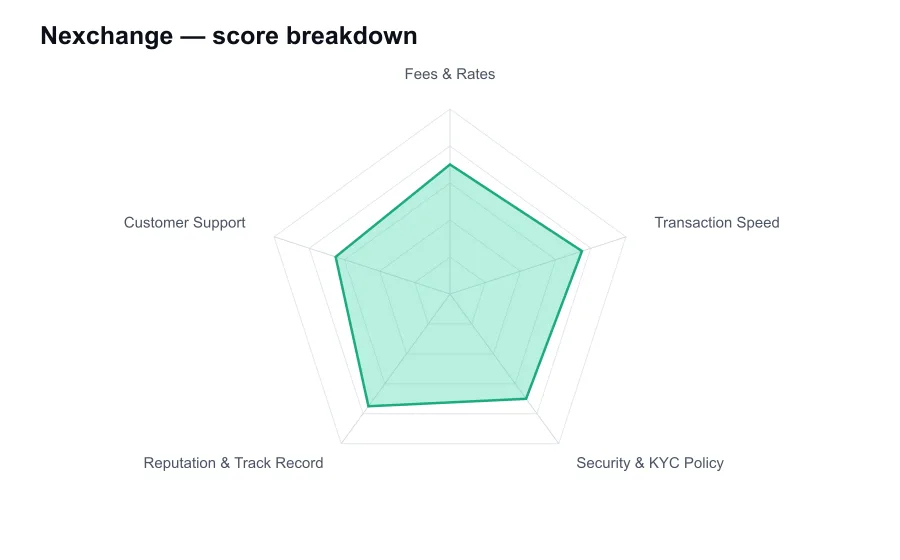
Nexchange scores 7.2/10 overall in our independent review, measured against every other provider we've compared, strongest on Transaction Speed (7.5/10) and weakest on Customer Support (6.5/10).

Status: active (checked 2026-10-13T18:36:47.963Z)

Editorial independence: our scores and rankings are produced using the fixed criteria above and are not influenced by advertisers. This is an independent ranking site and is not operated by, or affiliated with, any provider we list.

Affiliate disclosure: some links on this page may earn us a commission at no extra cost to you. This does not affect our rankings.

Nexchange: Nexchange is a credible, technically mature instant exchanger with a stronger foundation than the average retail swap site. Its API and operational history justify above-average scores for speed and reputation. The service still carries the normal centralization, spread, and compliance risks of its category. Use it for well understood conversions, and verify the delivered amount before approving the order. 7.2/10 How we score →
Best for Not for
Established instant-exchange and API provider Final quote can be beaten by competitors
Useful developer integration tools Risk-based KYC can interrupt a transaction
Market snapshot
AssetPrice (USD)24h change
Bitcoin (BTC)$82,317+0.72%
Ethereum (ETH)$2,443.73+0.37%
Tether (USDT)$0.9991-0.02%
BNB (BNB)$732.49+0.49%
Solana (SOL)$105.94+1.19%
XRP (XRP)$1.34+0.77%

Market data via CoinGecko, for informational purposes only. Not financial advice.

What is Nexchange?

Nexchange is a quote-based cryptocurrency conversion service and API provider. It lets users and integrated products swap one asset for another through a generated order, with output sent to a supplied wallet address. It is not an order book exchange or a long-term custody platform.

Criteria Breakdown

Scores for each criterion
Criterion Score Note
Fees & Rates 7.0 Competitive quotes, but compare final received amounts
Transaction Speed 7.5 Efficient processing after blockchain confirmations
Security & KYC Policy 7.0 Established operations, with risk-based compliance checks
Reputation & Track Record 7.5 Longer public record and established API presence
Customer Support 6.5 Useful documentation and tickets, limited hand-holding

Key Facts

Key data points for Nexchange
Fact Value Source
Official website n.exchange Source
Service type Instant cryptocurrency exchange Source
API access Available Source
Order model Quote-based wallet-to-wallet swaps Source
KYC model Risk-based verification Source
Custody model Temporary custody during processing Source

Review

Nexchange is one of the more serious instant-exchange providers in this group. It is a quote-based crypto conversion service with a consumer-facing swap tool and a developer-oriented API, rather than a conventional exchange where customers maintain a trading account and place limit orders. That distinction matters. Nexchange is built for conversion and settlement, not for active trading.

The company has been around longer than many copycat swap sites, and its API focus gives it a more substantial operating identity than a typical anonymous converter. Developers, payment businesses, and wallets can integrate exchange functionality without building their own liquidity operation. For ordinary users, that backend orientation can be a benefit because the service has to think about reliable order creation, callbacks, and transaction states.

Nexchange supports a broad set of crypto assets and uses a familiar flow. You choose the input and output currencies, enter an amount, provide a recipient address, then send the deposit to a generated address. The provider processes the trade and sends the output. There is no reason to leave money parked there, and the service should be treated as a temporary settlement counterparty rather than a wallet.

Fees require a little more scrutiny than promotional copy suggests. Nexchange has published a service fee model in the past, but the number that matters is still the final amount quoted for the exact pair and size. The quote may contain a provider fee, liquidity-provider costs, blockchain fees, and spread. That is normal for an instant exchange, though it means comparing a headline percentage alone can mislead.

For ordinary swaps, Nexchange is often competitively priced rather than categorically cheap. It is rarely the service I would choose blindly for the very best rate, because aggregators and large competitors may win on a particular pair at a particular moment. But its pricing tends to be intelligible enough for users who compare quotes. The key is to inspect the received amount before committing, especially for low-liquidity assets.

The service supports both fixed and floating-rate logic in contexts where the pair and market conditions allow it. A fixed quote is useful when you need to know what the recipient will receive, but it can carry a premium. Floating conversion can produce a better result if markets move favorably, while exposing the user to a worse result if the asset falls before the deposit is processed. That is a trade-off, not a flaw.

Transaction speed is respectable for an instant exchanger. Once the incoming transfer has sufficient confirmations, a straightforward liquid-pair order often completes quickly. The practical delay is normally the source blockchain. Bitcoin deposits can lag during congestion, and Ethereum transactions with low gas can sit for much longer than the user expects. Nexchange cannot settle an order before it can safely recognize the deposit.

Its API heritage matters here. Nexchange provides order statuses and integration tools that are genuinely useful to businesses and advanced users. A merchant or wallet developer can build a clearer payment journey around those states than they could around a basic retail swap widget. That does not guarantee every transaction will be perfect, but it is evidence of a provider designed for more than one-off retail clicks.

Security is competent but centralized. Nexchange takes custody of the input asset while an order is being processed, so there is unavoidable counterparty exposure. The reassuring part is that it has more visible operational documentation than many instant-exchange competitors. The less reassuring part is that no centralized swap service can give you the guarantees of a self-executing onchain transaction.

KYC is risk based. Most regular transactions can be completed without the account process users associate with centralized exchanges, but Nexchange can require verification or additional information where its compliance systems flag an order. This is a sensible policy from a legal and operational perspective, though it frustrates users who mistake no registration for a contractual guarantee that a transaction will never be questioned.

The terms and support materials deserve to be read before sending an unusually large amount. A review can affect the timing of a payout or refund, and the precise handling will depend on the order and the requested information. If you need certainty that funds will settle within a fixed deadline, an instant exchanger is the wrong rail. Nexchange is reliable enough for normal conversions, not a substitute for a bank wire with a service-level agreement.

Reputation is one of Nexchange's better points. It has a longer and more visible record than the obscure providers in this list, and its API has been used by third party services. That does not make it universally loved, because every exchange service accumulates complaints about rates, delays, and compliance holds. It does mean there is enough public operating history to judge it as a real business rather than a mystery webpage.

Support is adequate, not luxurious. Nexchange has help material and a support route, and technical users will appreciate the API documentation. Retail customers should still expect ticket-based problem resolution rather than immediate telephone assistance. For a missed payout, provide the order ID, input transaction hash, currency, amount, and destination address in the first message. It saves time.

Nexchange works best for users who understand how blockchain confirmations and floating rates work. It is particularly useful to developers who need exchange execution inside a product, because the API is a real differentiator rather than a decorative feature. For a casual customer making a simple major-coin swap, it is a credible option, though not always the cheapest live quote.

My view is positive with reservations. Nexchange is more mature and transparent than most small instant exchangers, and its technical infrastructure gives it a legitimacy edge. Still, users should compare actual output amounts and never assume a no-account transaction cannot be reviewed. It is a solid tool for routine swaps and integrations, but it is not the place to take shortcuts with large, deadline-sensitive transfers.
Pros and Cons

Pros Cons
Established instant-exchange and API provider -
Useful developer integration tools -
Broad crypto conversion use case -
Clearer operating history than small swap sites -
Suitable for routine wallet-to-wallet swaps -

How Nexchange Works

  1. Select the input and output assets
  2. Enter the amount and review the live quote
  3. Choose a fixed or floating option if available
  4. Enter the recipient wallet address
  5. Send the input asset to the generated address
  6. Track the order until payout is broadcast

KYC

Requirement optional
Notes Nexchange uses risk-based verification. A routine order may proceed without conventional account onboarding, but flagged transactions can require identity or source-of-funds information.

How to Use Nexchange Safely

  • Compare the final output with other live quotes
  • Use a fixed quote for deadline-sensitive payments
  • Confirm the destination network and address before sending
  • Keep the order ID and input transaction hash
  • Test API callbacks before accepting customer deposits

Is Nexchange an order book exchange?

No. Nexchange is primarily a quote-based instant exchange service. You create a conversion order and receive output to a wallet address rather than trading against an order book.

Does Nexchange have an API?

Yes. API access and integration tooling are a major part of Nexchange's offering, which makes it more relevant to wallets, payment products, and developers than many retail-only swap sites.

Does Nexchange require KYC?

Most routine swaps can start without a conventional exchange account, but Nexchange uses risk-based checks. It can request verification or transaction information for flagged orders.

Why is my Nexchange order still pending?

A pending order commonly means the deposit lacks required confirmations, the sending fee was too low, or the order is undergoing a risk review. Check the order status and your input transaction hash.

Should I choose fixed or floating rate?

Choose fixed rate when the exact output amount matters. Choose floating rate only if you accept market movement between deposit processing and settlement. The available option depends on the pair.

Can I use Nexchange for an app or wallet integration?

Yes. Its API-oriented design is one of its distinguishing features. Developers should use the official API documentation and test callbacks before routing live customer funds.

What should I provide to Nexchange support?

Send the order ID, deposit transaction hash, input amount and currency, destination address, and a concise description of the issue. This is faster than sending a vague request.

Editorial independence: our scores and rankings are produced using the fixed criteria above and are not influenced by advertisers. This is an independent ranking site and is not operated by, or affiliated with, any provider we list.

Affiliate disclosure: some links on this page may earn us a commission at no extra cost to you. This does not affect our rankings.

SC
Crypto Exchange Research Editor
Sophie Calder has spent nine years covering fintech, digital asset markets, and consumer trading platforms. She began by reporting on payment companies and moved into crypto after seeing how often new traders were being sold polished marketing instead of clear facts about cost, custody, and risk.
9 yrs fintech and crypto reportingFormer payments industry correspondentHands on exchange testingConsumer finance research editor
Nexchange score breakdown by criterion, shown as a radar chart
Score breakdown
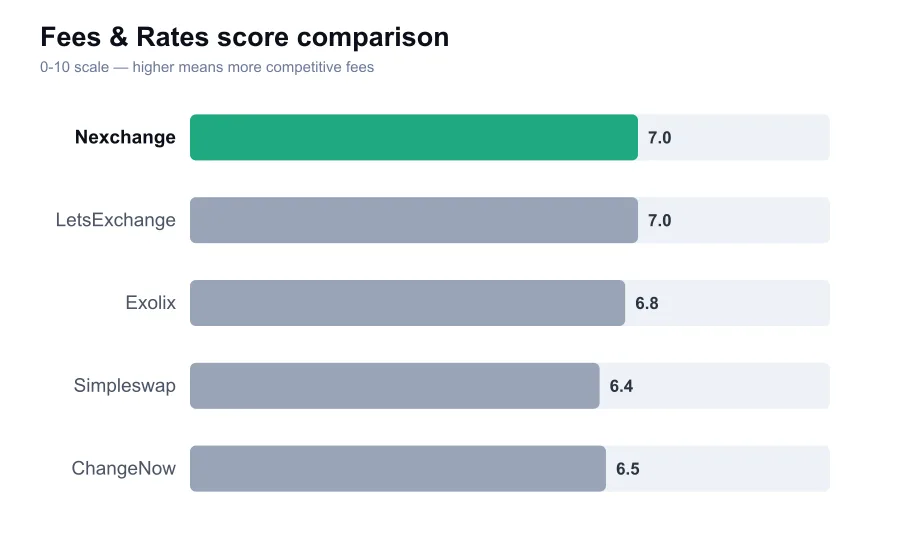
Nexchange fees score compared against similar providers
Fees vs. alternatives
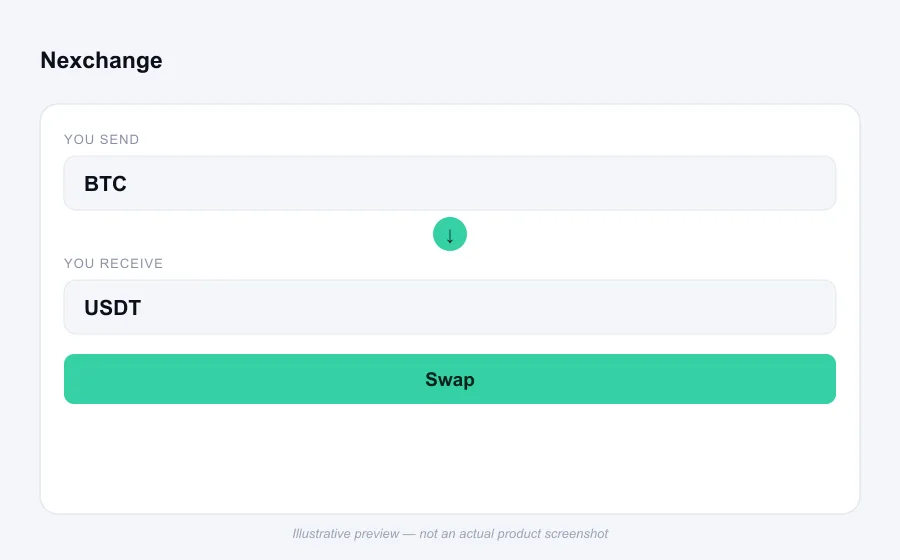
Illustrative swap flow preview for Nexchange - not an actual product screenshot
Illustrative swap flow preview

Alternatives to Nexchange

Alternatives to Nexchange
AlternativeScore
BitcoinVN Review7.3/10
LetsExchange Review7.3/10
Exolix Review7.4/10
Simpleswap Review7.0/10
ChangeNow Review7.5/10
EasyBit Review6.9/10