Godex is an instant crypto exchange aimed at people who want to swap coins without opening a trading account. It sits in the same broad category as ChangeNOW, SimpleSwap, StealthEX, and LetsExchange, but its identity is especially tied to fixed-rate swaps and a privacy-friendly, no-registration flow. The pitch is convenience, not sophisticated trading.
The site presents a familiar exchange form. Pick the asset you have, pick the asset you want, provide a receiving address, then send funds to the deposit address Godex generates. There is no order book to study, no candlestick chart, and no balance to manage. That makes the service approachable, though it also means users have less control over execution than they would on a spot exchange.
Godex has long advertised fixed exchange rates. That is useful in crypto because a customer knows the intended payout before sending funds, rather than watching a quoted estimate change while Bitcoin blocks confirm. Fixed quotes are especially attractive during sharp market moves, although users should read the transaction conditions closely because rate guarantees depend on sending the required amount within the specified timeframe.
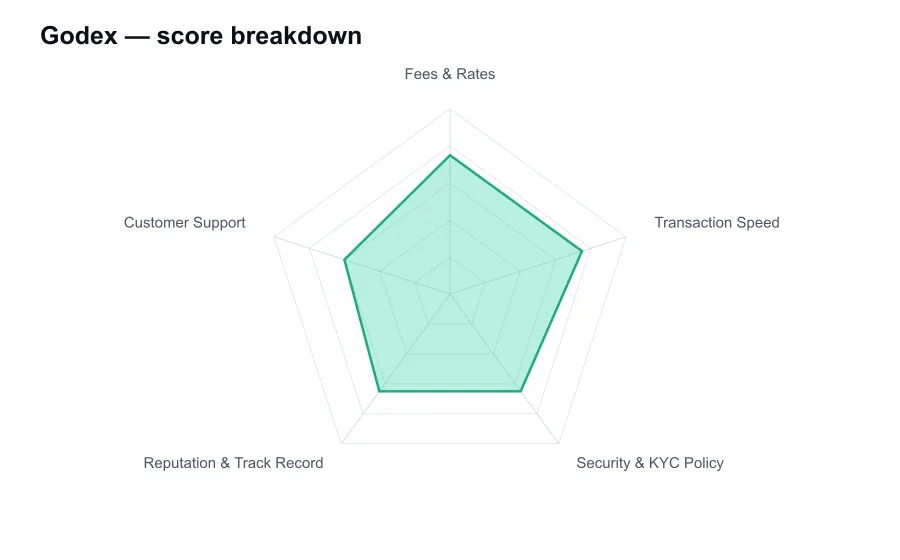
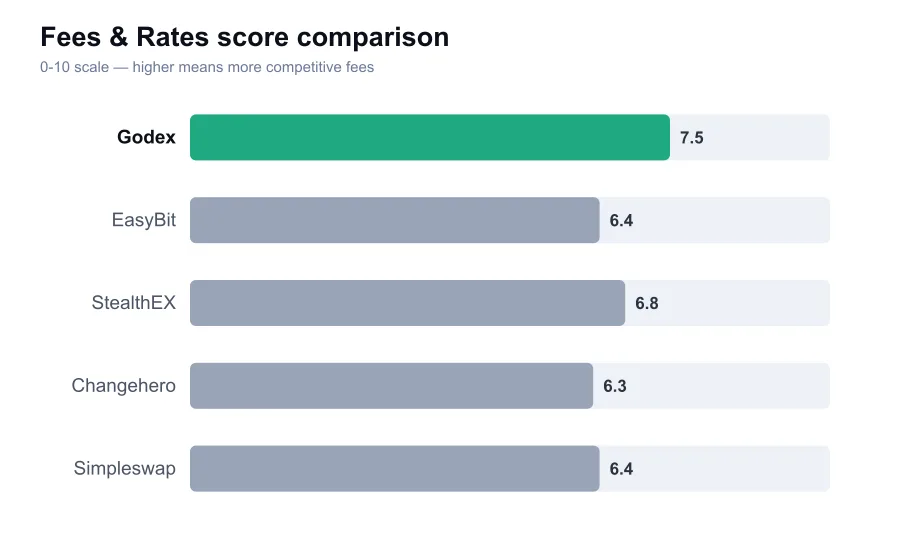
The provider's stated 0.5% commission is competitive on paper. It is cheaper than the 1% floating fee FixedFloat historically charged and sits in a reasonable range for a convenience service. Still, the headline commission is not the final comparison point. Godex quotes can include liquidity-provider spread, network fees, and risk allowance, particularly on illiquid assets or stressed chains.
For mainstream pairs, the convenience premium can be fair. For a small Bitcoin to USDT conversion, the difference from using a major exchange may be modest enough to justify avoiding registration. For larger transactions, or pairs involving obscure tokens, I would always compare the final output against at least two competitors. The quote, not the advertised percentage, is what the user actually pays.
Godex can be fast because it is heavily automated. Simple swaps often move through the system after the incoming transaction gets enough confirmations. That timing depends much more on the source chain than on the interface. A Tron transfer may settle quickly, while a Bitcoin payment with a low network fee can leave the order waiting for a long time.
The service does a reasonable job of reducing friction. It doesn't ask customers to create passwords, secure an account with two-factor authentication, or upload identity documents for standard use. That is appealing to privacy-minded users, but it shifts responsibility back to the customer. If you mistype your payout address or use the wrong network, there is no account dashboard that can rescue a completed blockchain transfer.
No-KYC should also be understood accurately. It means Godex has historically allowed ordinary swaps without routine identity verification. It does not mean the service is beyond compliance controls or cannot flag suspicious transactions. Any centralized instant exchanger can use blockchain analytics, freeze an order pending review, or respond to legal obligations. Privacy is a feature of the onboarding flow, not immunity from scrutiny.
Godex's security model is stronger for short swaps than for long-term holding because there is no obvious reason to keep an account balance with the company. That is a real advantage over custodial exchanges where users leave assets on platform. Yet a user still hands coins to Godex during execution. The company, its liquidity partners, and its hot-wallet procedures remain part of the trust chain.
The public reputation is mixed but not unusual for this part of crypto. Satisfied users tend to mention speed and the absence of registration. Negative reports usually involve delayed swaps, misunderstanding a floating quote, or dissatisfaction with a rate after comparing it to a spot market. There are also inevitable complaints around compliance reviews, which are frustrating but not unique to Godex.
I would not put Godex in the same trust category as a heavily regulated, long-established exchange with public financial reporting and a broad corporate footprint. It is a smaller, specialist service. That does not make it automatically unsafe, but it should affect position sizing. An instant exchanger is a tool for moving from one asset to another, not a bank account.
Support is available through the site's channels and order-specific communication, but it is an area where Godex feels functional rather than exceptional. The support test is not how quickly a simple question receives a reply. It is whether staff can solve a stuck order involving a missing tag, delayed confirmation, or an asset sent over the wrong supported network. Evidence here is uneven.
Godex is best used with disciplined expectations. Check the exact coin ticker, contract and network, confirm the output amount, and keep a record of the order page. Don't send a transaction from an exchange that might deduct a withdrawal fee after you have accepted a fixed quote, because that can leave the deposit short and complicate the order.
My view is that Godex remains a credible convenience option for small to medium, straightforward swaps where its quote is competitive. The fixed-rate focus and low-friction design are real strengths. It loses ground to better documented, more transparent providers for large transactions and to major spot exchanges for users who care most about price. Use it as a swap counter, not a place to store money or an institution to trust blindly.