Exolix is a non-custodial instant exchange that has become a recognizable name among users who want a fast crypto swap without opening a conventional exchange account. It competes directly with ChangeNOW, StealthEX, SimpleSwap and EasyBit. The service offers a broad asset and network menu, floating and fixed-rate transactions, and a simple web flow. It is stronger than many minor swap sites, though it still carries the basic trade-offs of an intermediary handling a one-time conversion.
The product is easy to use. Pick the coin you are sending, choose what you want back, enter a receiving address and send the requested amount. There is no trading screen, no order book and normally no need to create a profile. For a wallet user who needs to turn ETH into SOL or swap a stablecoin across supported routes, that is a much less intimidating experience than moving funds through a centralized exchange.
Exolix's range is one of its practical strengths. It lists a large set of coins and network variants, which matters because many users are not swapping only Bitcoin and Ethereum anymore. Network coverage can save a customer from the extra transfer and withdrawal steps required at a big exchange. The catch is that listing breadth is not equal to deep liquidity. A rare token can be selectable while still producing a poor rate or a slower fulfillment time.
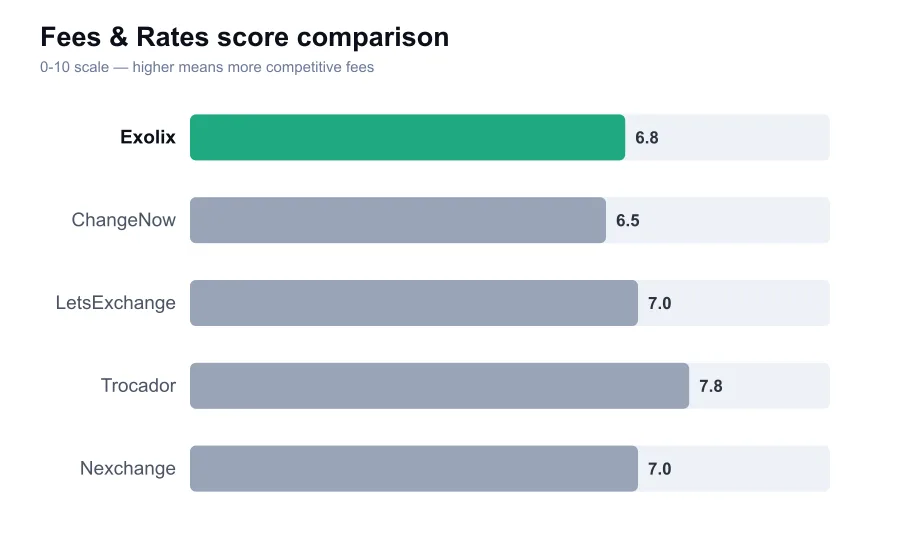
Fees are embedded in the quote. Exolix does not work like an exchange that posts a simple maker and taker schedule for every user. The payout estimate incorporates available liquidity, the service's margin and relevant network costs. This model is acceptable if users understand it, but it makes a headline claim of low fees less useful than the actual expected output. Compare the final amount, not just the displayed percentage or a spot price on a chart.
For common pairs, Exolix is often competitive enough to justify the convenience. For larger trades, it can be markedly more expensive than executing through a liquid order book. That is not a criticism unique to Exolix. It is the price of being able to swap without holding an exchange balance or completing conventional onboarding. My practical rule is simple: use it for convenience, not for price discovery. Get competing quotes from at least one other instant exchanger and a major exchange before moving a substantial sum.
Its fixed-rate option is valuable, especially on volatile pairs. A floating quote can shift between the moment you see the estimate and the point at which incoming funds receive confirmations. The fixed choice gives the user more certainty, provided the specified amount arrives in time and the transaction follows the exact instructions. It normally costs more because Exolix takes on the movement risk. That premium is sensible for a payment or a time-sensitive trade, less compelling for a casual swap.
Speed is generally good. Once the deposit is confirmed, automated routing and payout can be fast on chains such as Solana, Tron and Polygon. Bitcoin and Ethereum are less predictable because confirmation requirements and network congestion set the pace. The important distinction is that a delayed transaction is not always evidence of a bad provider. A block explorer can show whether the delay sits with the inbound chain, the outbound chain or Exolix's own processing.
Exolix gives users a transaction-status page, and that is more useful than it sounds. A status page cannot solve a problem, but it keeps customers from guessing whether the deposit has been seen. For a normal swap, that visibility is adequate. For a complex delay, users will still need responsive support and a clear explanation. The service has a decent record of handling routine transactions, yet no instant exchanger can guarantee that every liquidity partner or blockchain will behave perfectly.
The standard privacy appeal is that routine swaps can be started without registration or a standing exchange account. Exolix does not market this as a blank cheque for unrestricted activity. Its terms and risk controls allow it to screen transactions and request KYC information where compliance checks raise concerns. This is a sensible warning for users of any no-account exchange: accountless does not mean untouchable by AML controls.
That policy is the main security tension. Non-custodial exchange design means you are not leaving a lasting portfolio balance with Exolix. This cuts down the exposure associated with an exchange account breach. But when you send the deposit, the transaction is in the provider's operational pipeline. If it is flagged, you may have to provide documents before release. If you cannot tolerate that possibility, do not send funds with questionable provenance through any instant swap service.
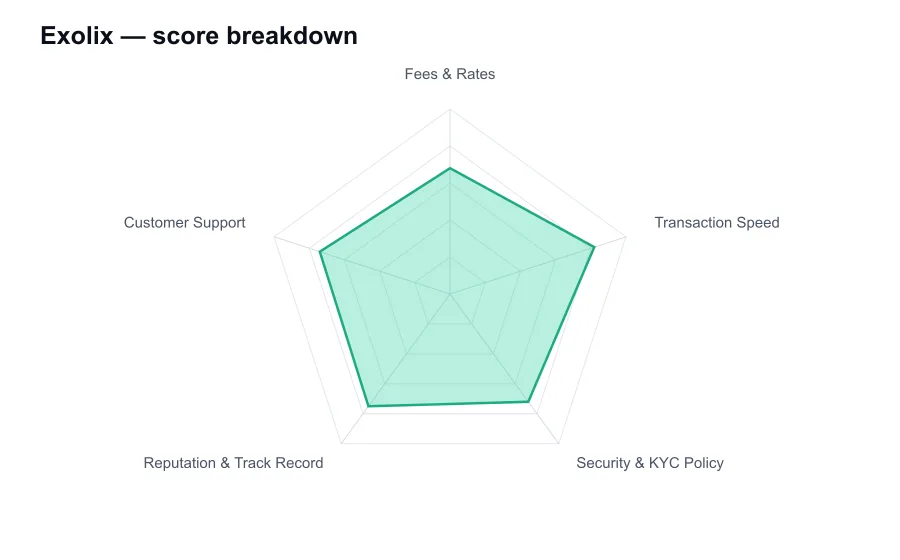
Exolix has a better public footprint than obscure swap brands. It has operated long enough to build name recognition in the exchange-aggregator space, maintains support material and is widely reviewed in the crypto community. It is still not a bank, a publicly audited custodian or a major regulated exchange. I would score its reputation as solid for this niche, not as equivalent to the strongest centralized venues. That distinction matters if your transaction is large or business-critical.
Support is offered around the clock through live chat and email channels. For ordinary problems, provide the transaction ID, input and output addresses, amount, timestamp and blockchain hash at the start. That saves back-and-forth. In fairness to Exolix, many customer complaints in this sector are really chain delays or incorrect deposits. In fairness to customers, the provider is still responsible for making instructions clear and communicating promptly when a transaction is under review.
Exolix's biggest operational risk for users is network confusion. Stablecoins and popular tokens are available on several chains, and an address that looks valid is not proof that it belongs to the chosen chain. Do not send an ERC-20 token to a TRC-20 route, and do not assume an exchange will recover a deposit sent without a required memo. Read the pair and network labels twice before pressing send.
The service is also better for completed swaps than for experimentation with tiny amounts. A network fee may consume too much of a very small conversion, and a minimum transaction threshold can make dust impractical. If you need to move a modest balance, calculate the final output against the total cost of making two transfers through a centralized exchange. Sometimes Exolix wins on simplicity. Sometimes the extra step is still cheaper.
Exolix is one of the more credible options in the instant-exchange segment. Its strengths are asset breadth, a useful fixed-rate choice, a mature enough user experience and no routine account requirement. It loses to major exchanges on fee clarity, institutional safeguards and deep-trade execution. I would happily consider it for a normal wallet-to-wallet swap after comparing quotes. I would not use it as a wallet, a primary trading platform or a place to send funds that may trigger a compliance dispute.