Trocador is one of the more interesting instant-exchange services because it is primarily an aggregator rather than a single swap desk pretending every route is its own. The site compares offers from multiple exchange providers and lets the user choose a route based on price, speed, rate type, and provider. That model gives it a useful place in the market. Instead of trusting one company's inventory and pricing, users can inspect competing offers without opening accounts at each underlying service.
Its design is deliberately plain compared with the glossy dashboards pushed by some exchange brands. That is a compliment. Trocador is built for a job: choose what you are sending, choose what you want back, compare offers, and execute. It does not distract users with yield products, leveraged trading, or a pile of account features they may never use. For self-custody users, that focus is one of its strongest qualities.
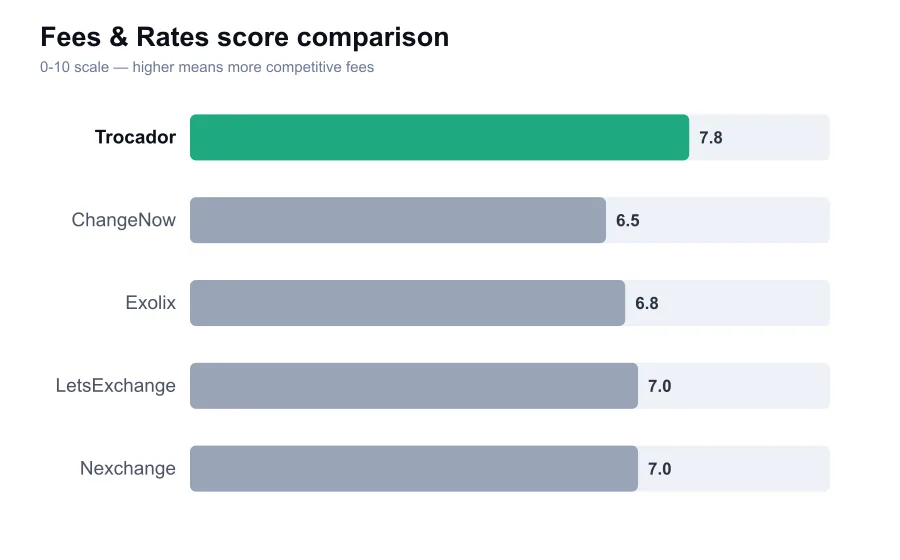
The central fee fact is simple. Trocador charges a 0.5% service fee on regular exchanges, incorporated into the quote. The rate supplied by the selected exchange partner still matters, and network fees still matter, so 0.5% is not the entire economic cost. A provider with a worse underlying rate can remain worse even if Trocador's own cut is transparent. Still, the visible service fee is a major advantage over platforms that leave users guessing how much spread has been inserted.
Trocador also offers its Troco loyalty system, which returns part of the service fee to users as Troco credits. That softens the cost for repeat customers, although I would not choose a route merely to accumulate a reward token or credit. The real test remains the amount landing in your wallet. For a one-off BTC-to-XMR or ETH-to-USDC conversion, a rival may occasionally beat Trocador. For repeated swaps, the 0.5% fee and rebate structure are easier to assess than opaque pricing from many competitors.
The comparison engine is particularly valuable because instant exchanges vary wildly by pair. One provider may be excellent for Bitcoin to Monero, another may price USDT on Tron better, and another might offer the only workable route for a smaller altcoin. Trocador gives users a chance to see that variation. It also displays provider names and exchange details rather than burying routing decisions completely. That transparency is rare enough to deserve credit.
Speed depends first on the underlying provider chosen. Trocador itself is not mining blocks, operating every liquidity pool, or guaranteeing the pace of a partner's compliance queue. On a routine route, a swap can finish shortly after the required deposit confirmations. Bitcoin-based transactions are usually slower than a conversion from a fast chain, while Monero can require significant confirmation time before a partner treats funds as final. Fixed-rate routes may involve different processing conditions from floating routes.
That dependence is not a flaw in the aggregator model, but it does place a burden on the user to read the offer details. Choosing the cheapest quote without checking the named provider, estimated time, minimum, and rate policy is careless. Trocador makes more information available than a typical one-click exchanger, and users should use it. If a transfer is time-sensitive, I would prioritize a well-known partner with a realistic estimate rather than save a few dollars on the lowest headline payout.
Privacy is part of Trocador's identity. The platform itself does not require an account for ordinary exchanges and has long attracted users looking for a simpler alternative to centralized exchanges. That is meaningful, but it has limits. Trocador routes swaps through third-party providers, each of which has its own risk systems and legal obligations. The absence of an account at Trocador does not guarantee that a partner will never hold a flagged transaction or ask for documentation.
Trocador's Protect feature is its most distinctive attempt to deal with the uncomfortable reality of third-party routing. For an added fee, Protect is intended to cover certain cases in which a selected provider creates a problem, subject to its terms and exclusions. It is not magic insurance and should not be described as one. A user still needs to read the conditions, retain the exchange ID and transaction records, and avoid sending funds connected to suspicious activity. But it is a more serious response to provider-risk than most aggregators offer.
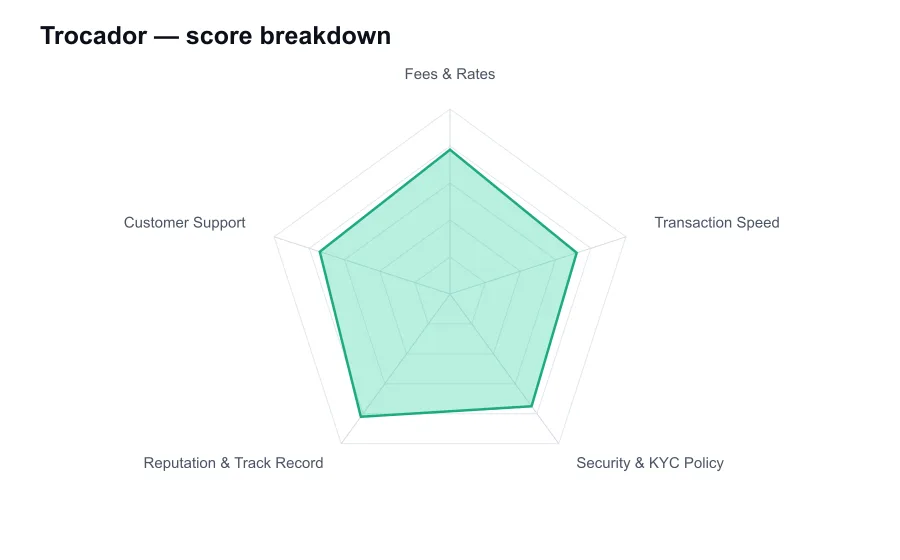
The company's reputation is stronger than its modest interface might suggest. Trocador has operated through several difficult years for the instant-exchange sector, a period that included liquidity failures, sanctions pressure, partner disputes, and widespread skepticism about no-account swap services. It has accumulated a recognizable following among privacy-oriented crypto users, particularly those who value access to Bitcoin and Monero routes. That does not mean every user report is positive. Delays and support disputes still happen, especially where a partner is involved.
Its reputation has also been helped by the fact that it does not conceal the awkward parts of its business model. Users can see that the final execution is often performed by another provider. That clarity is better than a service implying it controls a trade from beginning to end when it is really passing deposits onward. I trust a company more when it shows the plumbing, even if the plumbing means there are extra points of failure.
Support is competent for a service in this category, though it remains online support rather than the sort of staffed phone desk expected by institutional clients. The team can act as an advocate or intermediary where an exchange partner has a delayed transaction, and the Protect product gives it more reason to take problem cases seriously. Yet users should understand the limit: Trocador cannot always force a third party to release funds immediately. The quality of the response and documentation often determines whether a case moves forward.
The platform is particularly useful for Monero users, but that niche carries extra care requirements. Exchanges may have route-specific limits, and some providers do not support every coin in both directions. A deposit sent with the wrong payment ID, wrong network, or wrong amount can create a recovery problem. Trocador's interface reduces confusion, but it cannot protect users who ignore a destination tag, select the wrong USDT chain, or try to deposit after an exchange has expired.
I also like that Trocador encourages a more skeptical buying process. Its interface quietly teaches a good habit: compare providers, distinguish fixed from floating rates, and watch the output amount instead of fixating on a fee percentage. That is healthier than treating any instant exchange as a black box. The 0.5% service fee means it will not always win against a direct provider, especially for a large, straightforward pair. The trade-off is that you get broader visibility and an extra layer of recourse.
Trocador is not for everyone. Day traders will find the workflow slow and expensive next to a liquid spot exchange. People who need formal regulatory protections, insured custodial balances, and a named account manager should look elsewhere. But for self-custody users who value choice, want to compare several instant-exchange routes, and understand the risks of sending funds through third parties, it is one of the most credible tools in its segment. My view is clear: it is not frictionless, and it cannot eliminate partner risk, but it is more transparent and more thoughtfully designed than most of its direct rivals.