LetsExchange is a large instant-exchange aggregator that aims to make crypto swaps feel as simple as filling in a form. It does not try to be a full trading terminal or a place where customers maintain a portfolio balance. Instead, it connects users to liquidity for a broad range of assets and sends the acquired coin directly to a destination wallet.
That positioning has made it a visible competitor to ChangeNOW, StealthEX, SimpleSwap, SwapSpace, Godex, and similar services. LetsExchange's strongest claim is breadth. It has marketed access to thousands of cryptocurrencies and a very large selection of networks, which is useful for users trying to move between assets that are not available together on one centralized exchange.
The basic flow is clean. Select the asset you are sending, select the asset you want, choose a rate type where available, enter your payout address, then send the deposit. The order page tracks the transaction from deposit detection through exchange and payout. It is a much easier route than depositing assets at a centralized exchange, finding the pair, selling, buying, and withdrawing.
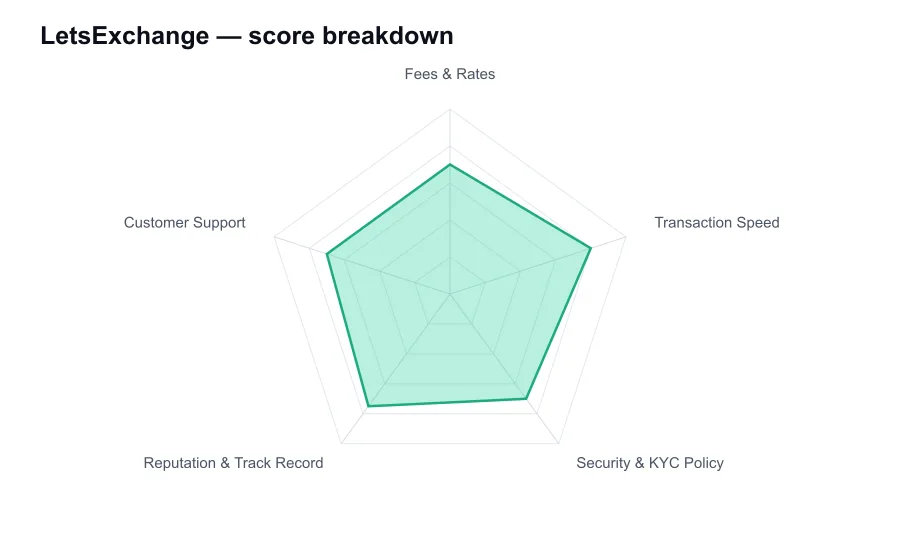
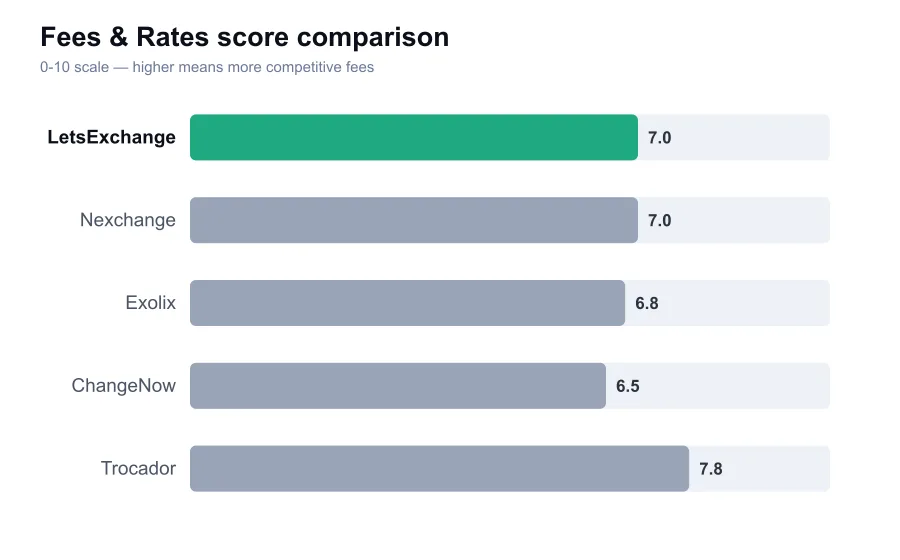
That convenience has a price. LetsExchange does not operate like a low-fee spot venue with a transparent maker-taker table. It obtains quotes through liquidity sources and the price shown can include provider fees, network costs, and execution spread. The company emphasizes that its service fee can start at 0.4%, but users should judge each order by the exact amount they will receive.
On liquid pairs, LetsExchange can be competitively priced, especially if a user values avoiding account registration and withdrawal delays. On obscure token pairs or cross-chain routes, rates can vary sharply between providers. I have no issue with an aggregator earning a margin for sourcing liquidity. I do have an issue when users compare only a stated fee and ignore the final output, which is where the actual economic decision sits.
The platform offers floating and fixed-rate options. Floating mode typically follows the rate available when the incoming deposit is received, so the output can move with the market. Fixed-rate mode aims to protect the quoted payout within the payment conditions. For volatile assets and larger orders, fixed mode is often preferable, though a customer should still verify the payment window and send the precise requested amount.
LetsExchange's transaction speed is good for the category, but it cannot outrun blockchains. A swap involving TRON, XRP, or a fast layer-two network may feel nearly immediate once deposits are detected. Bitcoin can take much longer because confirmation times and mempool fees are outside the company's control. Ethereum congestion and token approval mistakes can cause their own delays.
One real strength is network coverage. Crypto users increasingly need more than a list of coin tickers. They need the correct USDT version, the correct USDC chain, and a route that does not accidentally send an asset to an incompatible address. LetsExchange supports many networks, but that breadth also increases the chance of a user choosing the wrong version of a token.
The company generally permits swaps without mandatory account creation or routine KYC, which is one reason privacy-conscious users consider it. As with every centralized instant exchange, that should not be confused with a promise of unconditional anonymity. The terms provide room for anti-money-laundering checks, and transactions associated with risk signals can be paused pending clarification or compliance review.
Security is decent for a service designed around brief settlement rather than stored customer balances. LetsExchange directs output to a user-supplied wallet and does not ask users to maintain an exchange account. That limits exposure compared with leaving funds on a custodial platform for months. Still, each swap involves a temporary transfer of control to the service and its liquidity partners, so self-custody before and after the swap remains essential.
The provider has built a stronger public profile than tiny anonymous swap sites. It has maintained a visible website, partner integrations, product announcements, and a sizable catalog over several years. That is a meaningful positive. It is not equivalent to the disclosure standards of a public company, bank, or top regulated exchange, but it gives LetsExchange more track record than an unverified newcomer.
Customer support is available around the clock through chat and order assistance, and that matters more here than on a normal retail site. The difficult cases are network mismatches, deposits sent after a quote expires, missing destination tags, and compliance holds. LetsExchange has a reasonable support presence, but no instant exchanger can promise that every recovery case is quick or even technically possible.
The service works best for people who know how wallets and networks work but do not want the administrative burden of a centralized exchange account. It is less attractive for active traders. A frequent trader will usually get tighter spreads, better control, and lower effective cost by using a reputable spot exchange, then withdrawing only when needed.
LetsExchange is one of the more capable broad-coverage instant exchangers, and its product has matured beyond a basic one-pair swap widget. The asset selection, fixed-rate option, and direct-to-wallet flow are useful. My reservation is pricing transparency at the individual quote level and the inherent limits of support once an irreversible transfer has gone wrong. Compare quotes, choose networks carefully, and it can be a solid tool rather than an expensive shortcut.