Quickex

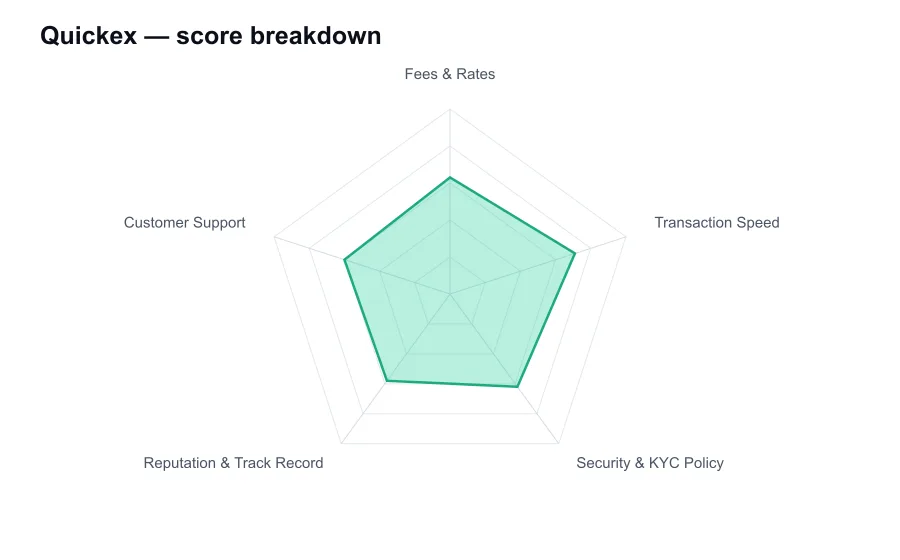
Quickex scores 6.3/10 overall in our independent review, measured against every other provider we've compared, strongest on Transaction Speed (7.1/10) and weakest on Reputation & Track Record (5.8/10).

Status: active (checked 2026-10-13T18:38:53.932Z)

Editorial independence: our scores and rankings are produced using the fixed criteria above and are not influenced by advertisers. This is an independent ranking site and is not operated by, or affiliated with, any provider we list.

Affiliate disclosure: some links on this page may earn us a commission at no extra cost to you. This does not affect our rankings.

Quickex: Quickex is a practical instant exchanger, provided you treat it like a convenience service rather than a bank or trading platform. Its uncomplicated flow and no-account approach are appealing for routine swaps. The price you pay is less fee visibility and the possibility of a compliance review after funds are sent. Test it with a small transaction, compare quotes, and use a self-custody wallet you control. 6.3/10 How we score →
Best for Not for
No account required for ordinary swaps Spread is less transparent than exchange trading fees
Floating and fixed quote options AML review can hold a completed deposit
Market snapshot
AssetPrice (USD)24h change
Bitcoin (BTC)$82,317+0.72%
Ethereum (ETH)$2,443.73+0.37%
Tether (USDT)$0.9991-0.02%
BNB (BNB)$732.49+0.49%
Solana (SOL)$105.94+1.19%
XRP (XRP)$1.34+0.77%

Market data via CoinGecko, for informational purposes only. Not financial advice.

What is Quickex?

Quickex is an instant cryptocurrency exchange service that lets users convert one asset into another from a wallet without maintaining a conventional trading account. It provides a quote, a deposit address, and a destination payout. Its rates are sourced through the service and its liquidity partners.

Criteria Breakdown

Scores for each criterion
Criterion Score Note
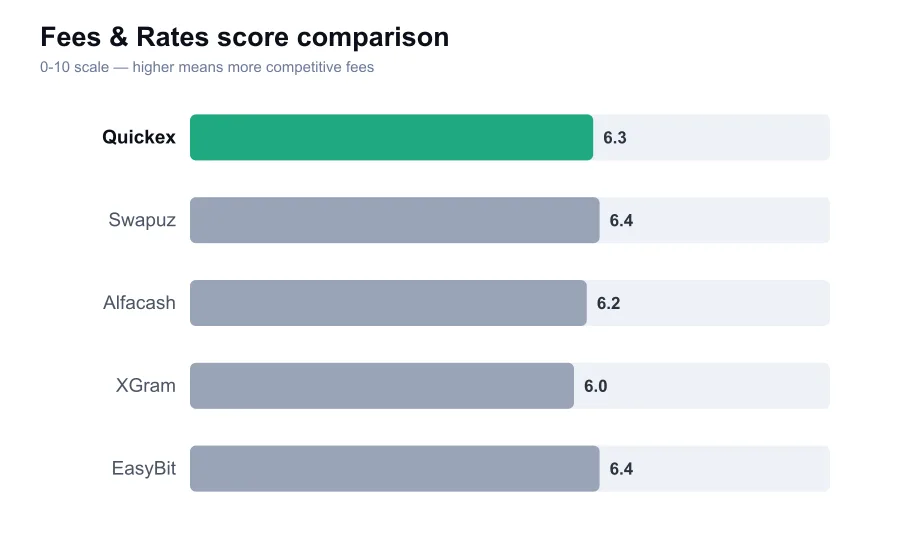
Fees & Rates 6.3 Rates include spread and network costs
Transaction Speed 7.1 Common swaps finish after network confirmations
Security & KYC Policy 6.2 No standing custody, AML checks can apply
Reputation & Track Record 5.8 Established instant-swap brand, limited transparency
Customer Support 6.0 Transaction tracking helps, escalations vary

Key Facts

Key data points for Quickex
Fact Value Source
Service type Non-custodial instant exchanger -
Account requirement Usually no account -
Rate modes Floating and fixed quotes -
Custody model Per-swap processing, no trading balance -
Verification model Risk-based AML checks -

Review

Quickex is a non-custodial instant crypto exchange service aimed at people who want to swap coins without opening a full trading account. It occupies the middle ground between bare-bones swap widgets and larger services such as ChangeNOW or SimpleSwap. The site is direct, fast to understand, and clearly designed for a user who already knows what asset they want to send and receive.

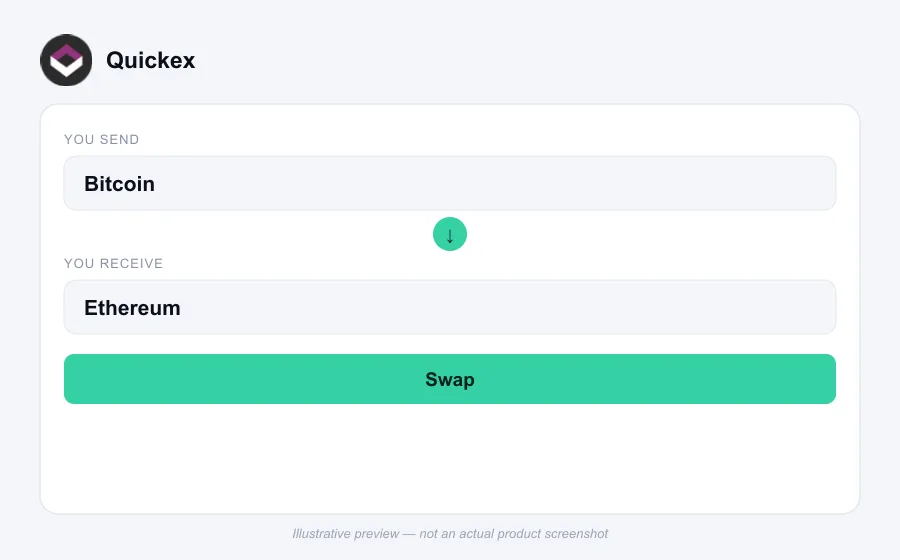
The basic flow is simple. Pick a pair, enter an amount and destination address, send funds to the generated deposit address, then wait for the provider and its liquidity partners to complete the swap. Quickex does not operate like a traditional exchange order book. You are accepting a quoted conversion through an intermediary service, which has consequences for pricing, support, and transaction certainty.

Fees are the first place where Quickex needs careful reading. It does not present a universal flat trading fee in the way a conventional exchange might. The cost is built into the quoted rate, along with network fees and the spread charged by liquidity sources. That is common in this category, but it makes comparison harder. A quote that looks convenient can still be noticeably weaker than a Binance, Kraken, or on-chain DEX execution for a larger trade.

For small, one-off swaps, that convenience premium can be perfectly reasonable. You avoid account setup, identity checks in routine cases, and the mechanics of moving funds between a centralized exchange and a wallet. For frequent users, though, Quickex is not cheap enough to treat as a default trading venue. Get quotes from at least two instant exchangers before sending, especially on Bitcoin, Ethereum, stablecoins, and other highly liquid pairs.

Quickex offers floating-rate and fixed-rate style conversions, depending on the pair and the quote available. Floating swaps are usually more attractive at first glance, but the received amount can change while your deposit waits for confirmations. Fixed quotes reduce that uncertainty, although they can carry a higher embedded spread and a short payment window. Neither mode is automatically better. The right choice depends on volatility and how quickly you can send.

Speed is usually respectable. Once the incoming transaction has the required blockchain confirmations, common swaps can complete in minutes. Bitcoin deposits may take longer because confirmation time is outside Quickex's control. Ethereum congestion, token contract processing, wallet delays, and liquidity-provider checks can also add time. The word instant should be read as a product category, not a guarantee of immediate settlement.

The service is non-custodial in the limited sense that it does not hold a standing balance in a customer account. That is better than leaving coins indefinitely on a small exchange. Still, every swap requires you to send funds to an address controlled during processing. For that period, the transaction depends on Quickex and its counterparties completing the conversion correctly. Non-custodial does not mean trustless.

Quickex says it uses AML controls and may request verification where a transaction triggers compliance concerns. That risk-based approach is typical for instant exchanges. It is attractive to privacy-conscious users because routine swaps can proceed without mandatory registration. It can be frustrating if a transfer is flagged after you have already sent funds, since the provider may request documents before release or refund processing.

That compliance reality is important for anyone moving funds connected with gambling services, sanctions-sensitive regions, mixers, high-risk addresses, or unusually large transfers. Do not assume that a no-registration interface means every transaction is anonymous or immune from review. If you cannot tolerate a temporary hold, use a regulated venue where the verification process is completed before you deposit.

Quickex's reputation is mixed but not alarming. It has been present in the instant-swap market for several years and has accumulated customer feedback on third-party review sites. Positive reports usually praise the uncomplicated flow and successful routine swaps. The recurring complaints are familiar for this sector: rate movement, delayed transactions, and users who expected a swap to be reversible after sending to the wrong network.

The company does not have the public corporate depth, licensed footprint, or long institutional record of Coinbase, Kraken, or Bitstamp. That does not make it unusable. It does mean you should size transactions accordingly. I would test it with a small amount before trusting it with a transfer that would be painful to have delayed for a day.

Support is available through the site's channels and transaction tracking tools. In normal cases, the transaction ID and status page are more useful than a generic support request because they identify where a swap is waiting. The weak point is escalation. Like many small instant exchangers, Quickex can feel responsive during a clean transaction and much less reassuring during an AML hold or a liquidity-provider issue.

The platform supports many mainstream assets and networks, but availability changes by pair. A coin appearing in the selector does not guarantee every network version is supported. USDT is the classic trap. A user must check whether the quote is for Ethereum, Tron, BNB Smart Chain, or another chain, then ensure the destination wallet accepts that exact version. A correct ticker with the wrong network can still create a costly recovery problem.

My view is that Quickex is useful as a convenience tool, not as a primary exchange. It is best for modest wallet-to-wallet conversions where speed matters more than shaving every basis point from the execution price. The lack of a mandatory account is a real advantage, but so is knowing where your money is if something goes wrong. For larger, recurring, or compliance-sensitive transfers, a more established exchange is the safer choice.
Pros and Cons

Pros Cons
No account required for ordinary swaps -
Floating and fixed quote options -
Wallet-to-wallet conversion flow -
Supports common coins and networks -

How Quickex Works

  1. Choose the asset and network you want to send
  2. Select the asset and destination network you want to receive
  3. Enter the recipient wallet address and review the quote
  4. Send the exact deposit amount to the generated address
  5. Track confirmations and receive the converted asset

KYC

Requirement optional
Notes Quickex generally allows routine swaps without registration, but AML monitoring can trigger a request for identity or source-of-funds information.

Supported Assets

Notable coins Bitcoin, Ethereum, Tether, USD Coin, Litecoin, Solana, TRON, BNB
Networks Bitcoin, Ethereum, Tron, BNB Smart Chain, Solana

How to Use Quickex Safely

  • Test a new asset pair with a small transfer first
  • Match the token network exactly to the quote
  • Check the final received amount before sending
  • Save the transaction ID and deposit hash
  • Never send from a sanctioned or high-risk source if you cannot complete KYC

Does Quickex require identity verification?

Routine swaps can be completed without a standard account signup, but Quickex can request KYC documents if its AML screening flags a transaction or address.

Is Quickex a custodial exchange?

It is an instant exchange rather than an account-based custodian. You send funds for each swap, but it does not provide a standing customer trading balance.

Why did my Quickex received amount change?

A floating-rate quote can move while your deposit is confirming. Fixed-rate quotes reduce price movement but may have a shorter payment deadline and a wider spread.

Can I cancel a Quickex swap after sending crypto?

Usually no. Once the deposit reaches the processing address, a blockchain transaction cannot simply be cancelled. Contact support quickly if the swap has not yet been completed.

What network issue causes the most problems?

Sending a token on the wrong network is a frequent issue. Check the exact USDT or USDC network shown in the quote, such as Ethereum or Tron, before sending.

How long does a Quickex swap take?

Many common swaps complete within minutes after the deposit confirms, but Bitcoin confirmation time, congestion, and compliance checks can make a transaction take longer.

Editorial independence: our scores and rankings are produced using the fixed criteria above and are not influenced by advertisers. This is an independent ranking site and is not operated by, or affiliated with, any provider we list.

Affiliate disclosure: some links on this page may earn us a commission at no extra cost to you. This does not affect our rankings.

SC
Crypto Exchange Research Editor
Sophie Calder has spent nine years covering fintech, digital asset markets, and consumer trading platforms. She began by reporting on payment companies and moved into crypto after seeing how often new traders were being sold polished marketing instead of clear facts about cost, custody, and risk.
9 yrs fintech and crypto reportingFormer payments industry correspondentHands on exchange testingConsumer finance research editor
Quickex score breakdown by criterion, shown as a radar chart
Score breakdown
Quickex fees score compared against similar providers
Fees vs. alternatives
Illustrative swap flow preview for Quickex - not an actual product screenshot
Illustrative swap flow preview

Alternatives to Quickex

Alternatives to Quickex
AlternativeScore
Swapuz Review6.4/10
Alfacash Review6.6/10
XGram Review6.0/10
EasyBit Review6.9/10
StealthEX Review6.9/10
Changehero Review6.9/10