Swapuz is a non-custodial instant exchange service that sits somewhere between a classic fixed-rate swap desk and a multi-provider exchange aggregator. You choose a pair, send coins to a generated address, and receive the requested asset in another wallet. It doesn't try to be a trading terminal, a lending app, or a full account-based exchange. That simplicity is attractive, especially for people who want to move between assets without parking funds on a centralized platform.
The service has positioned itself around broad asset coverage and several quote modes. In practice, the choice between floating and fixed rates matters more than the marketing language around it. A floating swap can produce a better quote at the moment of creation, but the final amount depends on market movement and the rate available when the provider processes the transaction. Fixed-rate swaps give more certainty, though they normally include a wider spread because someone is taking the price-risk.
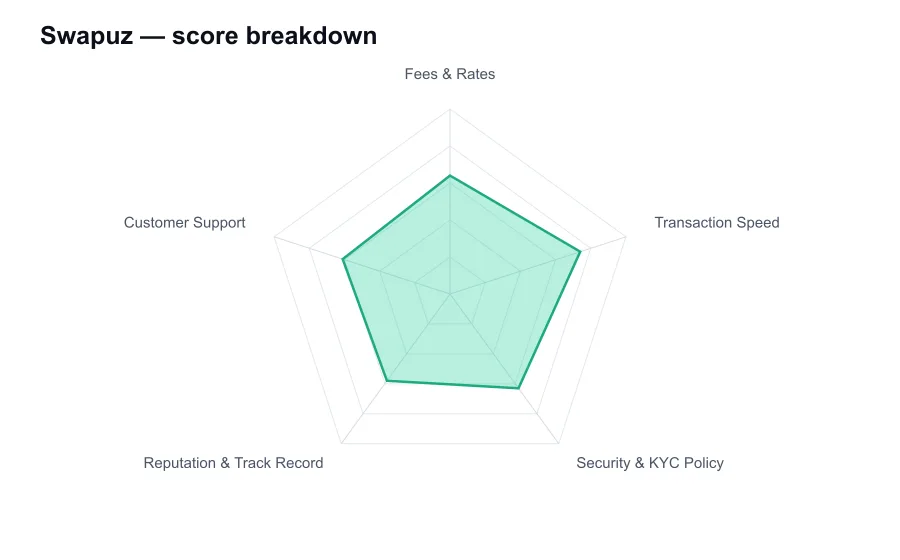
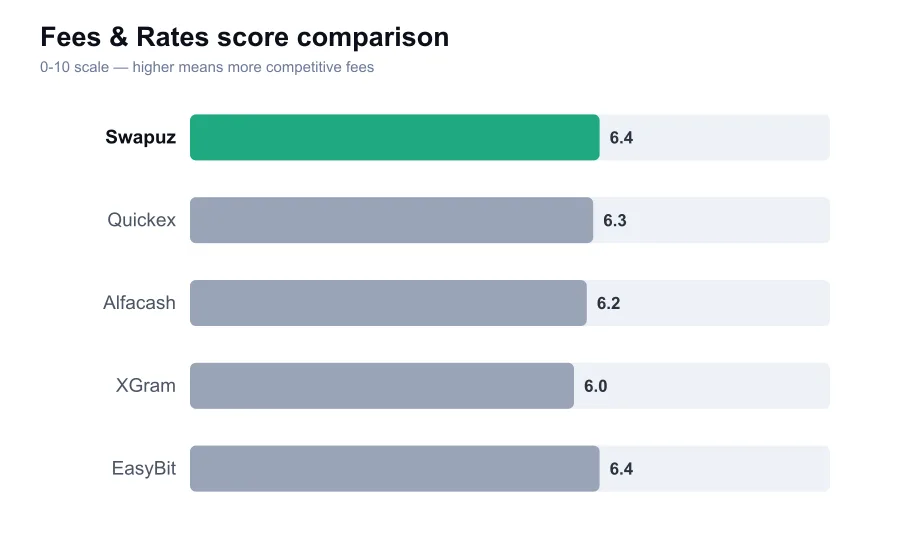
Fees are the first area where Swapuz needs careful reading. Like many instant exchangers, it doesn't present a single universal percentage that applies cleanly to every route. The quote incorporates liquidity-provider pricing, network fees, and the service's margin. That can be perfectly reasonable, but it makes direct comparison harder. A quote that looks cheap on the first screen can become less attractive once you compare the received amount against Kraken, Coinbase Advanced, or a self-directed swap on a liquid decentralized exchange.
For small conversions, the convenience can justify paying more. Sending one asset to an exchange, waiting for confirmations, placing an order, withdrawing again, and paying separate network fees is clumsy. Swapuz collapses that process into one transaction. For larger swaps, though, price discipline matters. I would always open at least two other instant-exchange quotes before committing. Services such as Trocador can be useful for that comparison because they show multiple providers rather than asking users to accept one route.
Swapuz is usually fast when the source network is behaving normally and the selected liquidity partner has sufficient inventory. Common swaps involving Bitcoin, Ethereum, USDT, USDC, Litecoin, and major layer-one coins can often complete in minutes after the required confirmations. That is not a guarantee. Bitcoin deposits can take substantially longer during mempool congestion, and Ethereum transactions with weak gas settings can delay the whole exchange before the provider can even begin processing it.
The important distinction is that Swapuz cannot make a blockchain settle faster than its confirmation rules allow. It can optimize the handoff after a deposit arrives, but users should treat a quoted completion time as an estimate, not a promise. Cross-network stablecoin swaps can also be slower than expected because the asset ticker may be familiar while the underlying rails are very different. USDT on Tron, Ethereum, BNB Smart Chain, Polygon, and Solana are not interchangeable deposits.
The non-custodial label deserves a precise interpretation. Swapuz does not operate like a custodial exchange where a user keeps an ongoing account balance under the company's control. Still, during an active exchange, the deposit is sent to an address controlled by the swap process or a liquidity partner. For that period, users rely on the service to identify the payment, complete the conversion, and send the payout. That is less exposure than leaving coins on an exchange account for months, but it is not trustless settlement.
The service advertises a no-registration experience for ordinary swaps, which is useful for privacy-minded users and anyone who dislikes creating another account. No routine registration should never be confused with an unconditional promise of anonymity. AML screening, sanctions controls, suspicious-transaction reviews, and requests for additional information can still arise. If a deposit is flagged, a swap can be paused while the provider asks questions or works through its compliance process. That is common across this category.
This is where Swapuz feels less mature than the strongest long-running names. A service can have a polished interface, a large list of coins, and quick completion reports while still lacking the multi-year public record that gives customers confidence during a difficult case. There is far more independent discussion of older brands such as ChangeNOW, SimpleSwap, and Trocador. Swapuz has visibility, but its reputation is still developing rather than settled.
I would not dismiss it solely because it is younger. Every established provider was new once, and some older instant exchanges have their own unresolved complaints. Still, users should calibrate the size of a transaction to the strength of the evidence available. A small test transaction is sensible before sending a large amount through any swap provider, and it is especially sensible where the brand has a lighter independent history than major competitors.
Support is available through the website's contact channels and live-chat style assistance. The quality of support matters most when a swap doesn't complete automatically, because routine transactions rarely need a conversation. The helpful test is whether the team can identify the transaction hash, explain the exact stage of processing, and give a meaningful status update rather than repeating that the request has been forwarded. Public feedback on support is mixed in the way it is for many instant exchanges, with smooth cases receiving little attention and delayed cases generating the loudest criticism.
Users should save the exchange ID, deposit address, payout address, and transaction hash before closing the browser. Those details are what support needs to investigate a missing or delayed payout. Sending a second deposit to the same address without instruction is a bad idea. So is changing the receiving address mid-case unless the support team explicitly confirms that it can do so safely.
Swapuz's asset selection is a real practical strength. It supports mainstream coins and stablecoins as well as a long tail of smaller assets, which can spare users from opening accounts at several exchanges. The trade-off is that obscure pairs can have weak liquidity. A platform can list a token without offering a particularly sharp rate or reliable depth for it. For thinly traded assets, I prefer converting through a liquid bridge asset such as BTC, ETH, USDC, or USDT, provided the extra transaction costs make sense.
There are also operational details that deserve more attention than people give them. Memo and tag coins, including XRP and XLM, require exact destination details. Network selection is equally serious for stablecoins. Sending an ERC-20 token when the quote expects a Tron-based token can create a recovery request that may be impossible or expensive. The speed of a one-click service does not remove the need to read the deposit instructions line by line.
Swapuz is best viewed as a convenience tool, not a venue for price discovery or a place to hold crypto. It works for users who want a quick wallet-to-wallet conversion, value account-free access, and are willing to compare quotes before acting. It is less compelling for active traders, people moving very large sums, or anyone who needs deep public proof of reserves, regulated-custody protections, and phone support. My take is cautious but not hostile: test it with a modest amount, use fixed rate when certainty is worth the extra cost, and don't mistake a smooth interface for the same level of assurance offered by a major exchange.