Baltex is a small instant crypto exchange service rather than a conventional centralized trading venue. The distinction matters. You do not come here for advanced order types, deep public liquidity, derivatives, or a regulated brokerage relationship. You come to convert one asset into another through a short form and a destination address. That is useful for a certain kind of customer, though Baltex operates in a part of the market where users should be especially selective.
The first thing I would say about Baltex is that it needs to earn trust transaction by transaction. It does not have the profile of a Coinbase, Kraken, Bitstamp, or Binance. There is less independent reporting, less public corporate detail, and less evidence of deep institutional infrastructure. That does not automatically make a service unsafe. It does mean a user should not grant it the benefit of the doubt that an established, heavily scrutinized exchange may have earned.
Its exchange flow is straightforward. Select the pair, supply the receiving address, send the deposit, and await the converted asset. For people who already understand wallets and network confirmations, this takes very little time to learn. There is value in that simplicity. A person swapping a modest amount of Bitcoin into a stablecoin does not necessarily need a fully featured trading terminal and a multi-step account verification process.
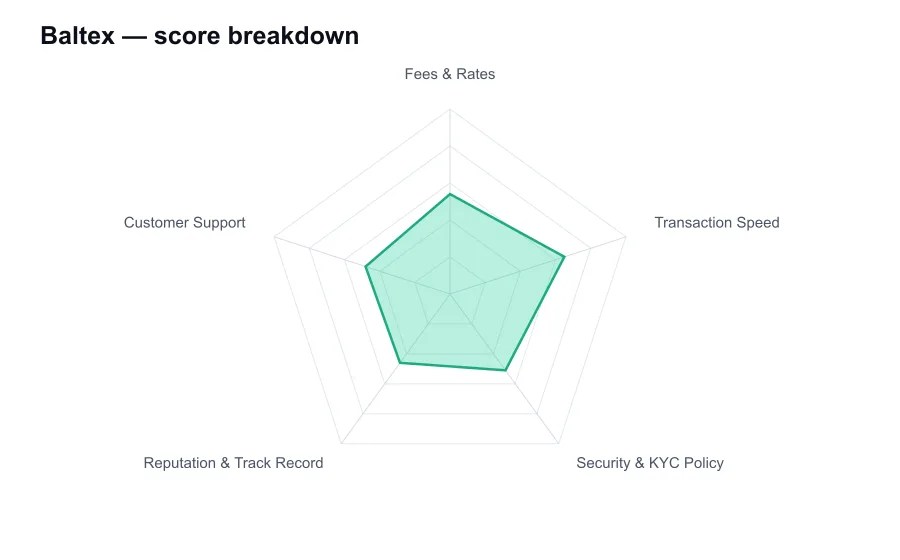
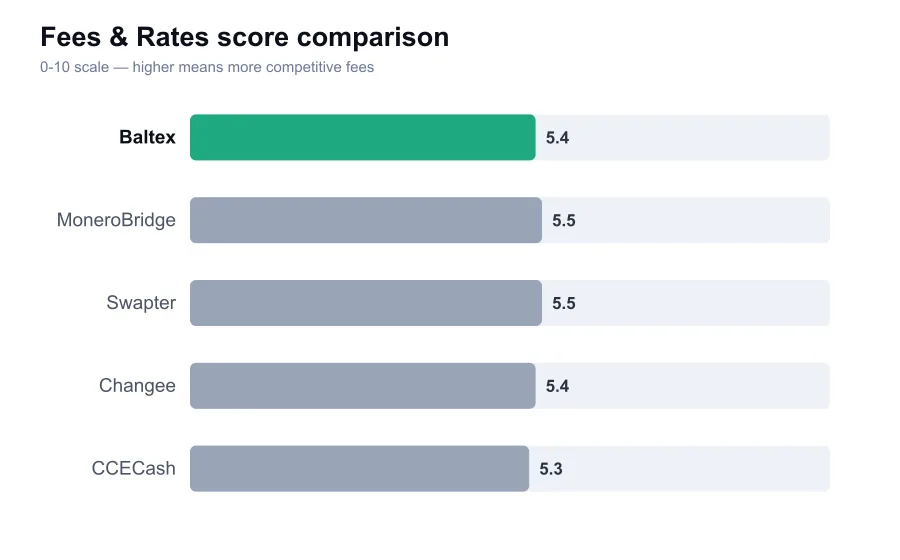
Pricing is the main area where the convenience model needs a skeptical eye. Baltex presents a conversion quote, but the cost is not usefully described by a single permanent fee number. The spread can change based on the pair, order size, available liquidity, and market conditions. That is normal for an instant exchange, but it also means the only fee comparison that matters is the net amount that reaches your wallet.
For a liquid pair, the spread may be acceptable. For a thin altcoin, it may be much worse than a customer expects. The problem is not that Baltex uses a quote model. The problem is that a quote model gives the provider more room to obscure the difference between the reference market price and the price a retail customer actually receives. Check a live quote against another instant exchanger and, if practical, against a major exchange's spot market.
Speed should be judged in the same practical way. The form itself is quick. The transaction is not complete until Baltex sees sufficient confirmations on the deposit chain, sources the counter-asset, and broadcasts the withdrawal. A fast network can make this feel nearly immediate. Bitcoin, congested Ethereum transfers, and deposits sent with inadequate miner fees can turn the same process into a wait.
I would not use Baltex for a time-critical conversion. A payment deadline, a liquidation risk, or a trade that depends on minute-by-minute timing should be handled through a venue with known liquidity and a more mature operational track record. Instant exchangers are excellent at reducing user-interface friction, but they do not remove blockchain settlement risk, automated compliance checks, or occasional manual processing.
Its KYC position should also be read carefully. Small swap services are often described as no-registration or no-KYC because a user can initiate a standard transaction without creating a full profile. That is different from a promise that no documents will ever be requested. Baltex can apply AML screening and may pause an order while asking for identity verification or an explanation of funds.
That risk is especially relevant for customers who receive coins from many prior addresses, use privacy tools, deal with sanctioned counterparties, or send unusually large amounts. A compliance review may be justified, but it is still disruptive if the funds are already in transit. Anyone who cannot tolerate a hold should choose a provider whose onboarding and compliance procedures are completed before they deposit meaningful money.
Baltex's reputation is the most difficult category to score generously. It appears to be a functioning specialist service, but it lacks the long public history and third-party scrutiny that give users confidence during disputes. There is no persuasive reason to treat a lesser-known exchanger as equivalent to a long-standing regulated platform simply because both display a clean swap widget. Trust in crypto is built from transparent ownership, responsive handling of problems, and a record that can be independently checked.
Support is likely to be sufficient for normal order questions, but that is a low bar. What matters is response quality when a transaction is delayed, a sender has used the wrong network, or a compliance review freezes progress. Smaller operators often have thin support coverage and fewer ways to escalate. Before sending funds, make sure you have captured the quote, order reference, deposit address, and transaction hash. Those records are your best tools if something goes wrong.
Baltex is not a service I would dismiss outright, but it is one I would approach with a small-first-transaction mindset. Test a low-value swap. Verify that the destination network is correct. Judge the received amount against the original quote. If the first experience is clean, the service may be useful for occasional convenience conversions. That is a much more sensible approach than trusting any unfamiliar exchange with a large first deposit.
The lack of elaborate features can be a benefit. There are fewer screens to misuse and fewer account settings to manage. Yet the same minimalism leaves less of a safety net. There is no order book you can independently inspect, no obvious institutional custody claim to rely on, and no reason to assume round-the-clock support at the standard set by a global exchange.
My view is clear: Baltex may suit a technically competent user who wants a small, uncomplicated swap and has compared the quote carefully. It is a poor fit for first-time buyers, large conversions, or users who require a clearly regulated counterparty. The service earns middling marks because it can perform the task it advertises, but its limited public track record means caution should be part of every transaction.