Changee is a small non-custodial instant exchange service aimed at people who want to swap one cryptoasset for another without opening a conventional trading account. It sits in the same broad category as ChangeNOW, ChangeHero, SimpleSwap and StealthEX, though it has far less public history and brand recognition than the larger names.
The pitch is straightforward. Choose an asset pair, enter a destination wallet address, send the deposit, and receive the converted coins. There is no visible order book, no advanced trading terminal and no custody account intended for long-term balances. That simplicity is useful, but it also means users must judge the quoted rate carefully before committing funds.
Changee presents floating and fixed-rate exchange options for selected pairs. A floating quote may move between the time a user creates an order and the time the incoming transaction receives enough confirmations. A fixed quote offers more certainty, although the rate can include a wider spread. This is normal for instant exchangers, but it is still the central cost question.
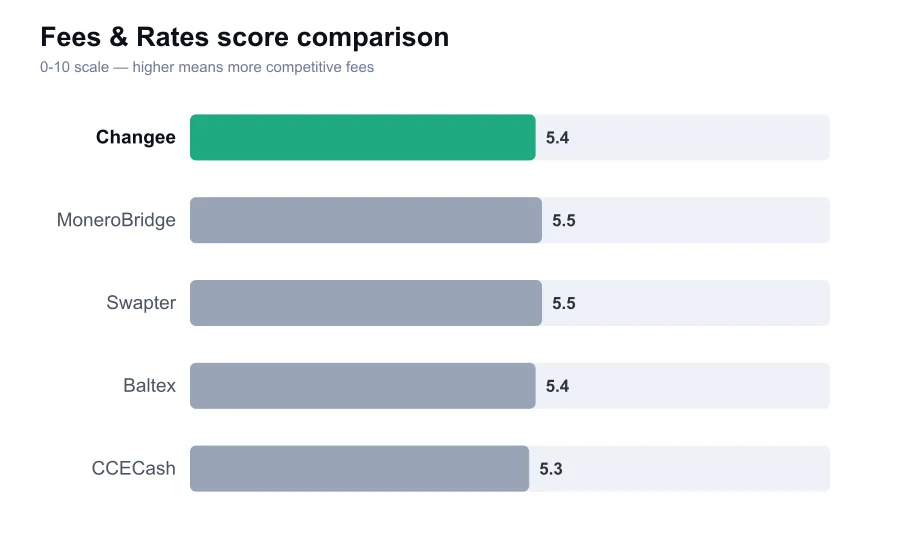
The service does not publish the sort of clean maker and taker fee schedule available on major centralized exchanges. Instead, its compensation is generally embedded in the displayed conversion rate, together with network costs and liquidity-provider pricing. That makes Changee convenient for a one-off swap, but poor for someone trying to compare execution costs precisely.
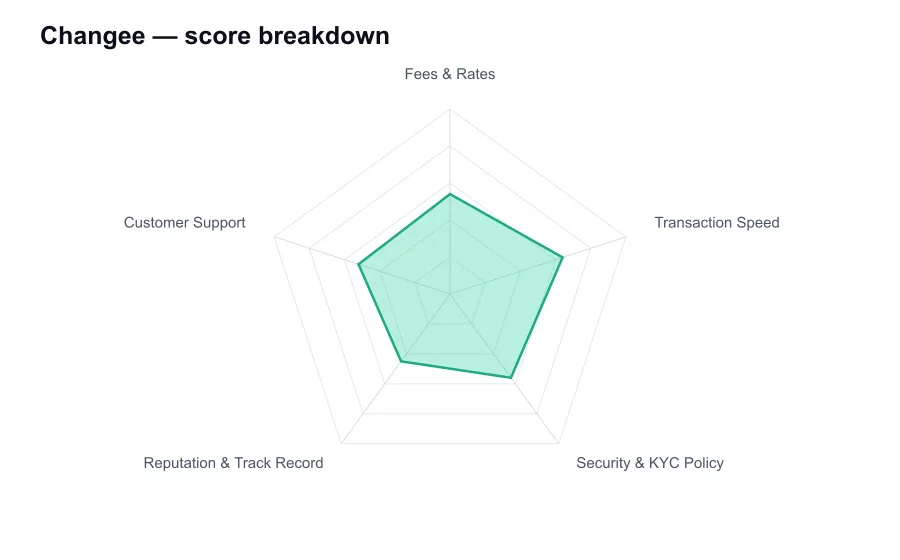
For small swaps, the all-in quote can be reasonable if liquidity is deep and the network is quiet. For larger orders, the lack of transparent fee separation is more troubling. A trader can see a rate, but cannot readily tell how much is network expense, how much is price movement, and how much is Changee's margin. That opacity holds its fees score down.
Speed depends more on the assets involved than the front end. A swap from Litecoin or XRP can settle quickly after the service detects the deposit. Bitcoin, Ethereum and congested token networks naturally take longer because confirmations and network conditions matter. Changee gives an order status page, which is helpful, but it cannot make a slow chain fast.
The practical risk lies in sending exactly the right asset on exactly the right network. Wallet interfaces often make networks look interchangeable when they are not. A USDT transfer sent through an unsupported route can become a manual recovery case, if recovery is possible at all. Changee's workflow is simple enough that users may rush past this point.
Like most no-account instant exchange services, Changee markets a low-friction experience rather than blanket anonymity. It can request identification or additional transaction information where its compliance systems flag an order. That is a more honest description than claiming there is never KYC. A user whose transfer triggers review may face a delay that is not obvious from the initial swap screen.
Non-custodial is a qualified benefit. Changee does not function like an exchange wallet holding a standing customer balance, so there is less exposure to a platform account breach. During an exchange, however, the service and its liquidity partners still control the deposited funds until settlement. A non-custodial label does not remove counterparty risk from an in-progress swap.
Public information about Changee's corporate record, liquidity sources and long-term operating history is thinner than it is for established competitors. That does not prove misconduct, but it matters. Crypto users should not treat a clean-looking interface as proof of deep operational maturity. The provider has not earned the same degree of independent, long-duration trust as ChangeNOW or several older services.
Support is available through the site's contact channels and transaction-specific assistance. The important test is not whether a chat icon exists, but whether support can resolve a delayed deposit, a wrong memo, or a compliance request quickly. Smaller providers have less visible evidence of scaled support operations, so I would not use Changee for funds I could not afford to have tied up temporarily.
The site is best approached as a utility, not a primary venue. Check the quoted output against at least one rival before approving a meaningful trade. On common pairs, that takes less than a minute and can expose a surprisingly wide gap. For a large exchange, splitting the order or using a liquid centralized exchange is usually more defensible.
Changee may appeal to users who value a short, account-light swap flow and are already comfortable managing self-custody wallets. It is less persuasive for active traders, businesses needing auditable fee records, or anyone who wants a long, independently verifiable operating record. The service has the right basic model, but it has not yet supplied enough public evidence to command blind trust.
My view is cautious rather than hostile. Changee can serve a modest, routine conversion if the displayed rate is competitive and the user verifies every network detail. Its weak point is not the idea of instant exchange, it is the limited transparency around pricing, operations and reputation. Keep the transaction size sensible, retain the order ID, and choose a more established venue for substantial value.