CCECash is a small instant cryptocurrency exchange service built around a familiar promise: choose a pair, send coins, and receive another asset without using a conventional trading account. That proposition is attractive to people who dislike centralized exchange dashboards or do not want to keep a balance on a platform. It is also a category where marketing claims need to be examined closely, because the quality gap between providers can be enormous.
The service should be approached as an execution tool, not a savings account or a primary trading venue. Its purpose is to facilitate a one-off conversion between wallet addresses. There is no compelling reason to leave funds with a small swap provider after the transaction finishes. The less money and time you expose to a lightly documented intermediary, the more control you retain.
CCECash's basic flow is easy to understand. Select the asset you are paying with, select the asset you want to receive, enter an address, and send the quoted deposit amount. If the transaction is processed normally, the target asset arrives at the address supplied. For a user already comfortable with blockchain wallets, that is a much simpler experience than registering at a major exchange, depositing funds, trading a pair, and requesting a withdrawal.
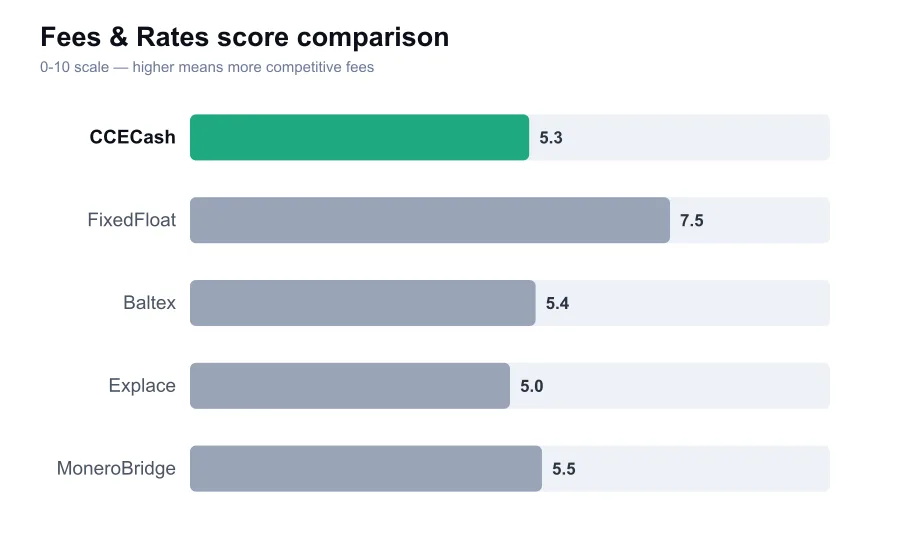
The trade-off is price clarity. Like many instant exchangers, CCECash's economic cost is contained within the conversion quote. A user may see a rate, but the real question is how it compares with the market price and with competing swap services at that exact moment. The spread is not fixed across all pairs. Liquidity, volatility, network fees, and the provider's own risk margin can all affect the payout.
This makes it a poor choice for anyone who is price-sensitive or converting a large amount. Even a seemingly small percentage difference can become expensive on a substantial trade. A major exchange with visible order books may require more setup, but it allows a customer to see the market price, choose a limit order, and separate trading fees from withdrawal fees. CCECash is for simplicity, not for transparent best execution.
Speed can be good in ideal conditions. A deposit on a fast chain with a correctly paid network fee can be recognized quickly, and a liquid payout asset can be sent soon after. That is the favorable scenario. The less favorable scenario involves Bitcoin confirmation delays, Ethereum congestion, a token network mismatch, or a transaction diverted to manual review. Instant exchange does not mean instant blockchain settlement.
This is why users should avoid sending assets needed for a deadline. Do not use an unfamiliar exchanger to make a rent payment, cover a leveraged position, or fund an urgent purchase. A delay of several hours may be irritating for a casual conversion. The same delay can be financially damaging if the transaction is tied to a time-sensitive obligation. CCECash does not offer the operational certainty that such uses demand.
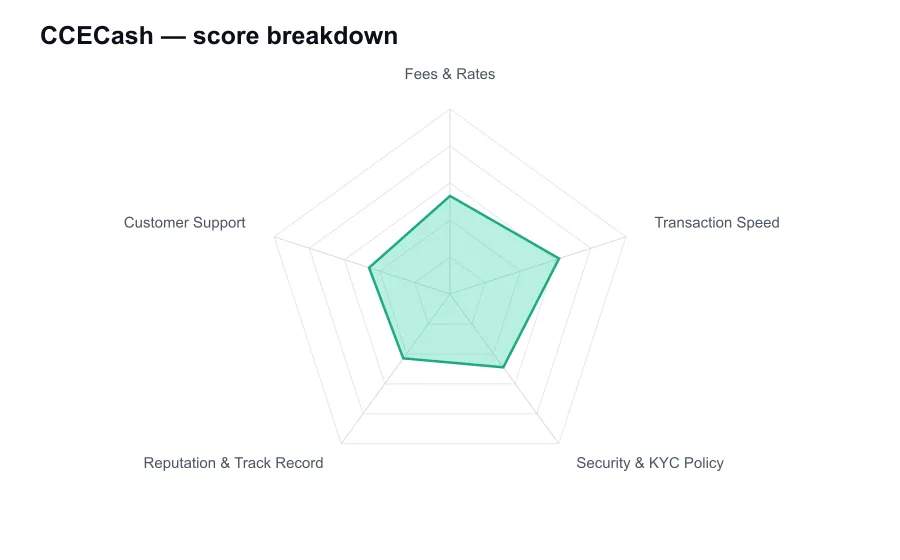
The security question has two layers. First, the site has to safely process deposits and payouts. Second, it has to handle customer data and compliance requests responsibly if a transaction is flagged. CCECash has a much thinner public profile than long-established exchange brands. That does not prove misconduct, but it limits the amount of independently verifiable confidence a customer can place in it.
The practical implication is simple. Keep transaction size conservative and avoid assuming that a no-registration flow means no verification risk. AML screening can still occur. If the provider asks for documents after the deposit arrives, you could face a frustrating choice between providing information and waiting for the matter to be resolved. Users who know they need a fully verified, predictable fiat or crypto relationship should complete onboarding at a mainstream exchange before moving meaningful funds.
Reputation is CCECash's weak spot. It is not widely recognized as a major industry institution, and there is relatively little public evidence of the governance, audits, corporate disclosures, or customer-protection structures that serious users should want from a custodian. A clean website and a long list of assets should never be enough by themselves. In crypto, the quality of dispute resolution matters far more than the appearance of the checkout page.
Support should be treated in the same cautious way. It may be capable of answering a normal order query, but a user should plan for the possibility of slow or limited resolution if a transfer is complicated. Before initiating an order, take screenshots of the exchange rate, the payout amount, and the order details. Keep the deposit transaction hash. If a ticket is necessary, those facts matter much more than a general description of the problem.
Network selection is a particular risk with this type of service. Stablecoins can exist on several chains, and token tickers do not always communicate the chain being used. Sending USDT on an unsupported chain is not a minor typo. It can create a recovery problem that is costly, slow, or impossible. CCECash users should verify the exact deposit instructions, not merely the asset symbol.
A small test transfer is more than a cliché here. It is the correct risk-management method. Test whether the quoted amount is close to the delivered amount, whether the service recognizes your deposit promptly, and whether the payout reaches the wallet and network you expect. If a provider works well on a small transaction, it has earned a little more confidence. It has not earned unlimited confidence.
My assessment is guarded. CCECash may be useful for experienced users making small wallet-to-wallet swaps where convenience matters and the live quote is competitive. It is not a provider I would use for a large balance, a first major purchase, or an urgent transfer. The lack of a strong, easily verified public reputation weighs more heavily than the convenience of its short exchange flow.