Explace is a smaller crypto exchange provider that appears aimed at quick conversions rather than full-scale trading. It belongs to the part of the market where a user wants to send one asset and receive another without dealing with order books, custody balances or advanced charting. That can be a useful service, but Explace has a much lighter public footprint than the best-known names in instant exchange. That gap shapes nearly every part of this review.
The appeal is obvious. A direct conversion form is easier than registering at a centralized exchange, funding an account, trading a pair and withdrawing to a wallet. For someone who has a small balance in one coin and needs another for a payment or transfer, the reduced friction is attractive. Explace should be judged as a narrow utility, though, not as a replacement for a regulated venue, personal wallet or professional trading platform.
The site experience matters because these services ask users to act quickly. A good instant exchange makes the sending asset, receiving asset, network, minimum and expected payout unambiguous before money leaves a wallet. Explace's users should pay close attention to those details rather than relying on a familiar token ticker. The same asset may exist on several chains, and a network mismatch is one of the most common causes of expensive support cases.
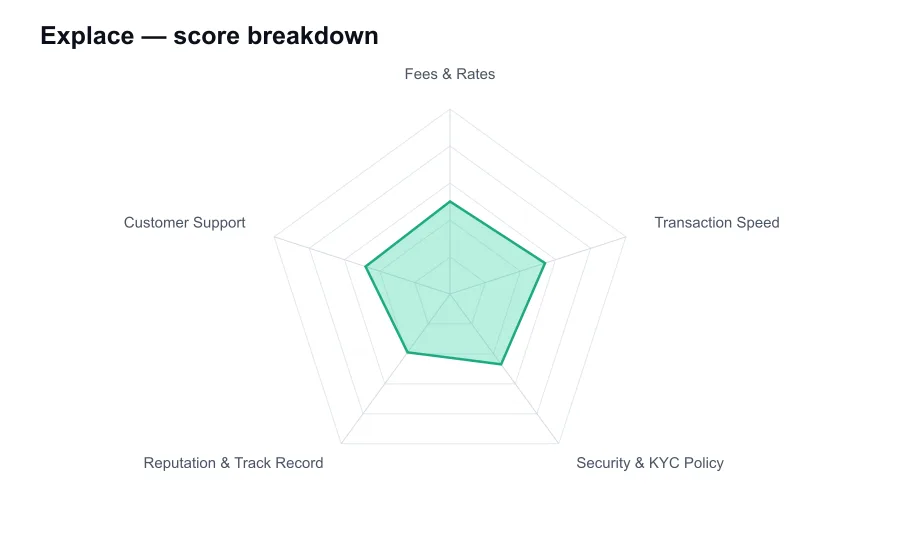
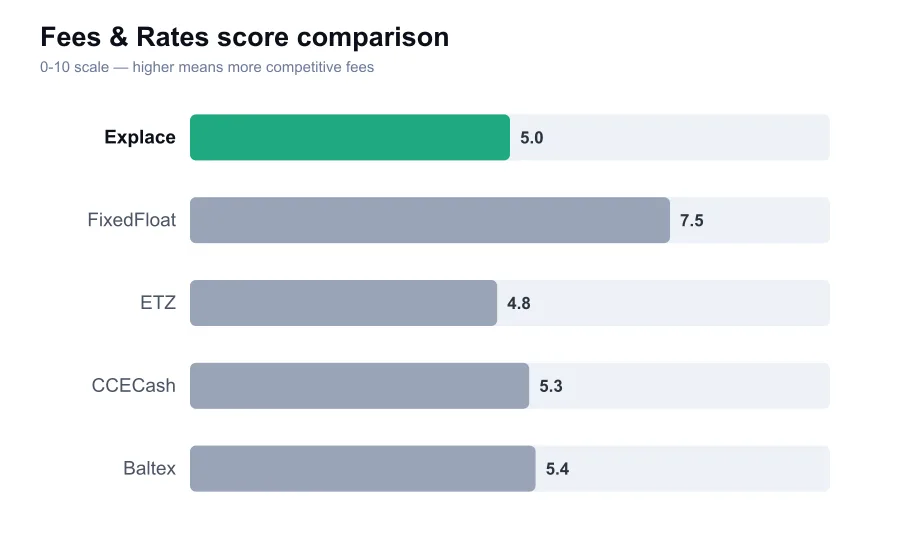
Price is the first point where I would be skeptical. Smaller instant exchangers rarely provide the depth of fee disclosure offered by order-book exchanges. Rather than a public maker and taker fee schedule, the customer receives a quoted payout. That quote can include liquidity costs, network charges and a service margin. The only number that matters is how much reaches your wallet, not a claim that a transaction has no commission.
A quote-based model is not inherently unfair. It gives a user a single number and removes the need to calculate separate trading and withdrawal costs. But it also makes comparison mandatory. Before accepting an Explace rate, obtain the same pair and amount from Exolix, EasyBit, ChangeNOW or another established competitor. For common pairs, a gap of even a fraction of a percent can decide which service is sensible. For illiquid pairs, the difference may be much larger.
Explace may be acceptable for a small, convenience-led swap if its live quote wins. It is not where I would send a large balance simply because it appears first in a search result. The lack of deep public information around pricing methodology, liquidity relationships and trade execution makes it hard to know whether a good quote is consistently good or merely favorable at one moment. Transparent venues earn trust by making these mechanics visible.
Transaction speed is partly out of any exchanger's hands. Bitcoin deposits take confirmations. Ethereum can become expensive or congested. Some chains require memos or have unusual finality behavior. Explace can only control its own detection, routing and payout process. Without a broad, independently visible record of fulfillment times, I would rate its speed as unproven rather than poor. A small test transaction is the only responsible way to assess a route you have not used before.
The same caution applies to technical interruptions. A route can be unavailable because a wallet is under maintenance, a liquidity partner has paused a token or a blockchain is congested. Larger platforms usually publish notices, maintain detailed status systems and have more customer reports to cross-check. With a smaller provider, the user may have to rely mostly on the information presented during the transaction. Do not assume that an asset shown in a selector is instantly available in every network variant.
Security in this category is often described with the word non-custodial. That description can be useful, but it needs precision. You do not normally keep an ongoing account balance at Explace. Once you send a deposit for a swap, however, you have entrusted the service and its execution partners with the conversion. This limits long-term custody exposure, but it does not eliminate counterparty risk during the transaction.
KYC can be equally misunderstood. A service may allow a swap to start without account registration, while reserving the right to investigate a transfer flagged by AML monitoring. That is common practice and may be legally necessary. The risk for users is practical rather than theoretical: a no-registration transaction can still become a document request. If funds have a complicated history or you cannot provide evidence of origin, choose your route carefully and do not assume any swap provider will ignore risk signals.
Reputation is Explace's weakest category. I cannot place it alongside mature brands with years of broad user reporting, well-established corporate information and extensive public support records. A smaller name may still perform perfectly well, but confidence should be earned, not borrowed from the instant-exchange model itself. The lack of a strong public track record does not justify allegations. It does justify a conservative score and conservative transaction sizing.
Support should be tested before use, not after a problem. Ask a specific question about a network, transaction minimum or token variant and judge whether the reply is timely and technically accurate. Generic assurances are not enough. A competent agent should know the difference between a blockchain delay, a pending deposit and an incorrect network. If Explace cannot provide clear pre-sale answers, that is a reason to stop before you generate a deposit address.
There are a few habits that sharply reduce the danger. Use a wallet you control, not an exchange withdrawal route you cannot reverse. Confirm the output address in full. Check whether the asset requires a tag or memo. Save the quote and blockchain transaction ID. Then, especially for a first transaction, send the minimum practical test amount. These steps are mundane, but they protect against most user-caused losses in an instant swap.
Explace could have a role for an experienced user who finds an unusually good quote on a supported route and is happy to test it with a small amount. That is a narrow recommendation. It is not a service I would suggest to a newcomer who needs hand-holding, a business paying suppliers, or an investor transferring a large holding. Those users are better served by exchanges with clearer accountability and more established support operations.
My final take is cautious rather than hostile. Explace may deliver the simple conversion it promises, and smaller services do not deserve automatic dismissal. But a weak public record and limited verifiable operational detail leave too much unanswered for a high-confidence recommendation. Compare its quote, verify every network detail and treat the first transaction as a test. Until its transparency and long-term reputation improve, keep transaction sizes modest.