MoneroBridge is a specialist instant exchange focused on a narrow task that many mainstream services handle cautiously: swapping into or out of Monero. That focus gives it a clear audience. People who want a direct Bitcoin, Litecoin, or stablecoin to XMR conversion often value speed, minimal account friction, and a service that understands Monero addresses and payment IDs. It does not make MoneroBridge a low-risk choice.
The service sits closer to a convenience broker than an exchange in the traditional sense. Users do not place order book trades or hold an account balance. They submit one asset, MoneroBridge processes the conversion through its own liquidity arrangements, then it sends the output to a destination wallet. That simplicity is useful, but it means the provider is the counterparty during the swap.
Its main appeal is the privacy-oriented flow. MoneroBridge has historically marketed swaps without a conventional account setup, which is attractive to users who do not want another exchange login or a full identity verification process for routine conversions. That should never be read as an unconditional promise. Any centralized service can screen transactions and ask questions where it believes legal or risk obligations require it.
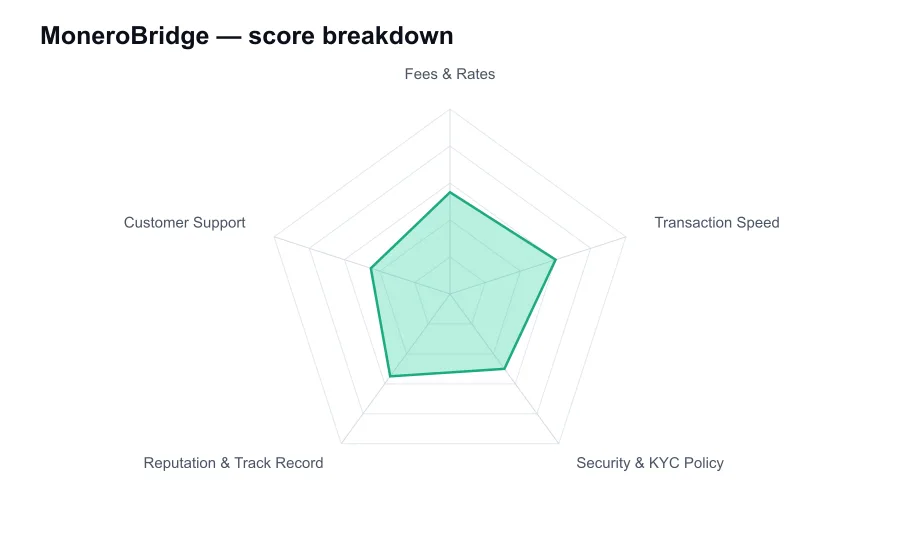
I would describe the KYC position as conditional rather than truly absent. The normal path may not require documents, but a flagged transaction can still be held while the provider asks for information. This is especially important for Monero users, because a privacy coin swap can draw more scrutiny than a simple ETH to USDC conversion. Do not send funds if you are unwilling or unable to respond to a compliance request.
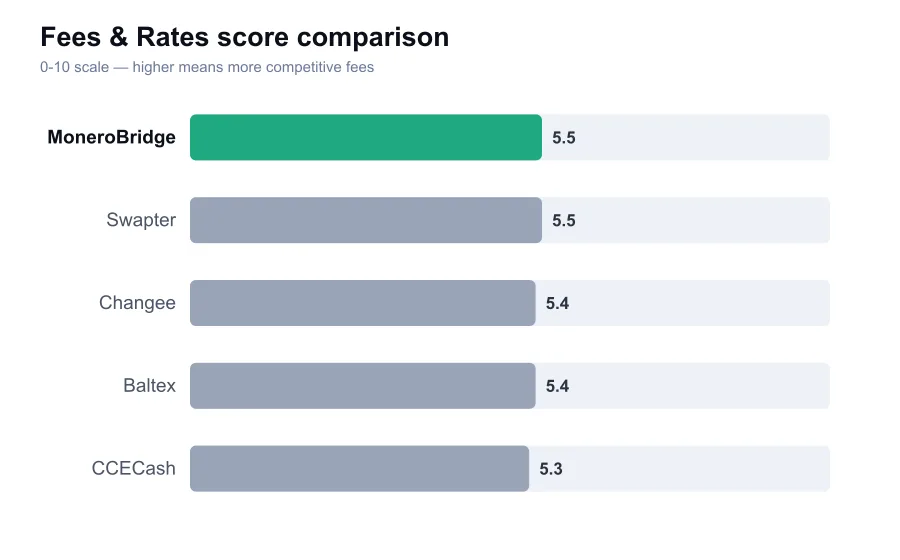
Fees are not MoneroBridge's strongest selling point. Like most instant exchangers, the meaningful cost is the all-in quote, not just a headline percentage. The quoted output can reflect liquidity costs, provider margin, blockchain fees, and volatility protection. Monero's liquidity is generally thinner than Bitcoin's, so the spread can become noticeable, particularly during a market rush or for larger orders.
That does not mean every quote is bad. For smaller XMR conversions, paying a modest convenience premium can be rational if the alternative is opening a centralized exchange account, waiting for withdrawals, and exposing more personal data. But users should check MoneroBridge against at least two alternatives at the exact same moment. A few minutes can make a visible difference in the delivered XMR amount.
The exchange-rate option deserves attention. A floating quote may improve if the market moves in your favor, but it can also produce less output after deposits and confirmations arrive. A fixed quote provides more certainty but commonly contains a wider margin. For a time-sensitive payment, fixed output is usually worth considering. For an ordinary rebalance, compare both modes if the service offers them for the selected pair.
Speed is generally constrained by the asset being sent in. A Bitcoin deposit needs network confirmation and can take substantially longer during fee spikes. Monero transfers also require confirmation before a provider can safely release funds. Once a deposit is recognized and liquidity is available, the conversion itself should be fairly quick, but users should budget more than the optimistic minutes shown in marketing copy.
MoneroBridge's narrow focus is both an advantage and a concern. It is likely more familiar with XMR-specific details than a broad consumer exchange whose Monero support is an afterthought. Yet it has a much smaller public footprint than the large instant-swap brands. There is less independent material to judge how it handles disputed rates, delayed payouts, or compliance holds.
Security depends heavily on user behavior. The most common failure is sending the wrong asset on the wrong network, entering a malformed Monero address, or losing the transaction reference. MoneroBridge cannot reverse a completed blockchain transfer just because a customer copied an address incorrectly. Use a wallet you control, verify the entire destination address, and avoid sending directly to a third party's exchange deposit wallet.
The service is also not a wallet. It should not be treated as a place to store XMR or any input coin. The safest pattern is to send the output directly to a self-custody wallet, confirm receipt, then keep your recovery material offline. If a swap fails, the order identifier and deposit transaction hash are the pieces support will need first.
Support appears to be a weaker area than the actual swap proposition. Small specialist exchangers often rely on email or ticket communication rather than staffed live help. That can be adequate for a straightforward transaction, but it is frustrating during a held transfer, especially when price movement is large. Before sending, find the support contact and read the refund terms.
Reputation is mixed rather than disastrous. MoneroBridge is known in the Monero-adjacent exchange niche, and that is more than can be said for an anonymous new swap page. Still, it lacks the scale, regulatory visibility, and extensive independent review history of bigger brands. I would trust it more for modest, routine conversions than for a five-figure transfer.
MoneroBridge makes sense if your priority is a direct route into or out of XMR and you understand the limits of an instant exchange. It is not the place for users who require a guaranteed settlement time, transparent institutional compliance procedures, or a customer support team with a public service-level commitment. Those users need a larger regulated platform, even if the onboarding is less pleasant.
My take is that MoneroBridge is useful, but it should be used with disciplined expectations. Its specialization is real value for Monero users, and the account-light flow is convenient. The price for that convenience is counterparty risk, limited public transparency, and support that may feel thin when something unusual happens. Keep transaction sizes sensible and compare every quote.