CoinCraddle is a far less established name than ChangeNOW, ChangeHero or the major centralized exchanges. Publicly verifiable information about its ownership, operating history, liquidity arrangements and regulatory footing is limited. That fact shapes this review more than any polished promise on a website could. In crypto, missing evidence is itself a risk signal.
The service appears to present itself as a crypto conversion provider rather than a conventional exchange with a transparent order book. That model is not automatically bad. Instant exchange tools can be useful. But a provider asking users to send irreversible assets needs to show clearly who runs it, how support works, what happens during a hold and how pricing is calculated.
CoinCraddle does not have the widely documented multi-year public record of ChangeNOW, which dates to 2017, or ChangeHero, which dates to 2019. I could not verify a similarly reliable founding date from authoritative public materials. I therefore would not assign it the benefit of a long track record merely because it is accessible online.
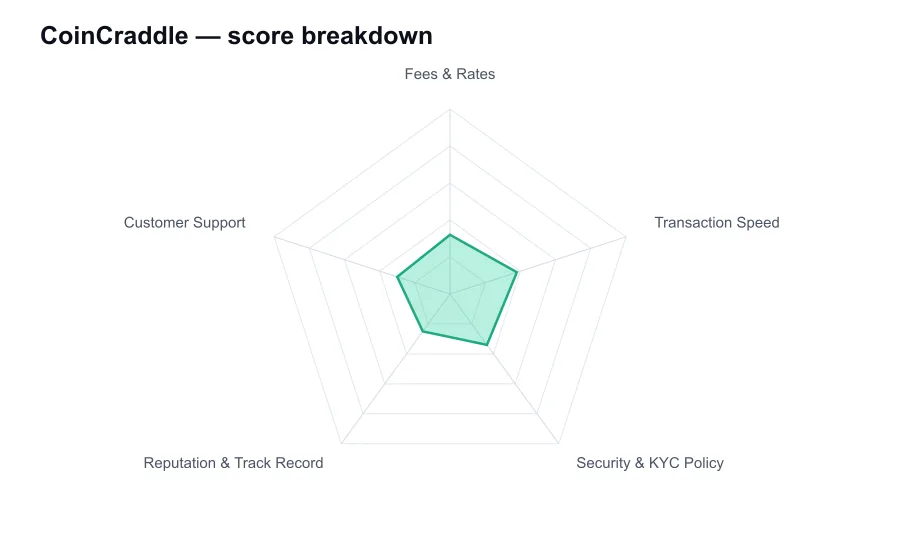
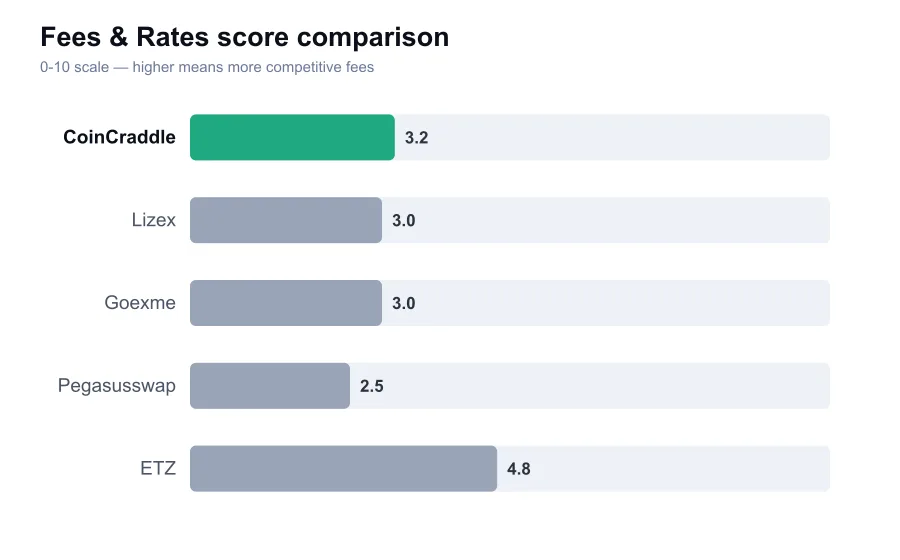
Fee transparency is the first concern. A credible exchange should either publish a fee schedule or make it easy to understand the spread embedded in its conversion quote. With CoinCraddle, there is insufficient dependable public information to establish a universal fee rate. That does not mean every quote is poor, but it means users cannot responsibly assume that it is competitive.
A user considering CoinCraddle should compare the precise amount received against at least two better-known services. Do this immediately before committing, using the same pair and transaction size. If CoinCraddle cannot beat the quote materially, there is little reason to accept its additional reputation risk. A lower headline price is meaningless if execution or recovery is uncertain.
Speed claims are equally hard to assess without a substantial body of independently documented completed transactions. Every instant exchanger depends on blockchain confirmations, network fees and liquidity availability. A new or obscure provider adds another variable, operational capacity. A fast-looking checkout page does not establish that a service can handle exceptions promptly.
Security is not just a question of HTTPS, wallet addresses and a non-custodial label. Users need to know whether deposits are held directly, routed through third parties, screened by AML tools, or subject to delayed manual review. CoinCraddle does not offer enough clear, independently verifiable operational detail for me to give it a strong security score.
The lack of clear information has practical consequences. If a transfer is delayed, a user should know the legal entity, support escalation route, policy for wrong-network deposits and conditions under which identity documents may be demanded. These are not obscure edge cases. They are routine failure modes in the instant-exchange business, where transactions cannot simply be reversed.
A small provider can occasionally deliver good support precisely because a human responds quickly. It can also fail badly when it lacks staff, documented processes or liquidity relationships. I found too little reliable evidence to credit CoinCraddle with either strength. That uncertainty is worse than an ordinary negative review because prospective users cannot judge the probability of a bad outcome.
There is also a basic reputational problem. Established crypto businesses receive criticism, but they leave a visible trail of announcements, policies, independent discussion and time-stamped user experience. CoinCraddle's limited public footprint makes it difficult to distinguish a young legitimate operation from a weakly documented one. Responsible reviewing requires saying that plainly.
This does not justify calling CoinCraddle fraudulent. There is a serious difference between a lack of verified information and proof of wrongdoing. But it does justify a conservative recommendation. Crypto transfers are final, and a user does not need to prove a service malicious before deciding that a more transparent competitor is the better home for funds.
If someone still chooses to test CoinCraddle, the only sensible approach is a very small transaction using a mainstream asset and the exact intended network. Do not send a large first deposit. Do not send from an address requiring a memo unless the workflow clearly supports it. Preserve screenshots, the order reference and the blockchain transaction hash.
I would also avoid providing identity documents until the user has independently verified the provider's legal identity, privacy policy and support domain. A compliance request can be legitimate, but sensitive documents should never be uploaded casually to an operation whose public accountability is unclear. That is sound practice with any small crypto service.
CoinCraddle's score reflects evidentiary weakness, not a claim of demonstrated loss or wrongdoing. It may improve if it publishes clear company details, fee methodology, support commitments, compliance terms and a stable record of user resolution. Until then, it cannot compete credibly with established instant exchangers on trust, regardless of how simple its interface may be.
My take is blunt. CoinCraddle is not a provider I would recommend for meaningful amounts because too many basic questions remain unanswered in public. There are established alternatives with clearer policies, broader reputational evidence and proven support channels. If you are merely curious, test with money you can afford to lose or delay. If the funds matter, choose a better-documented service.