Pegasusswap appears in the crowded category of small cryptocurrency swap providers, a category where presentation is cheap and credible operational history is not. It offers the kind of simple conversion proposition that appeals to users who want to move from one coin to another without opening a full trading account. The problem is that Pegasusswap has not developed the public footprint needed to inspire much confidence.
There is a meaningful difference between a service being accessible and a service being proven. A swap page can generate a deposit address, show a rate, and still leave important questions unanswered. Who legally operates it? How long has it processed customer funds? Where are its terms, escalation channels, and security disclosures? Pegasusswap is difficult to assess against those basic measures.
That does not prove misconduct. It does mean prospective users should refuse to fill the gaps with optimism. Crypto transfers generally cannot be reversed, and an unknown intermediary has no obligation to earn trust merely because it offers a familiar-looking exchange form. For Pegasusswap, the burden should be on the operator to provide stronger evidence than I could verify.
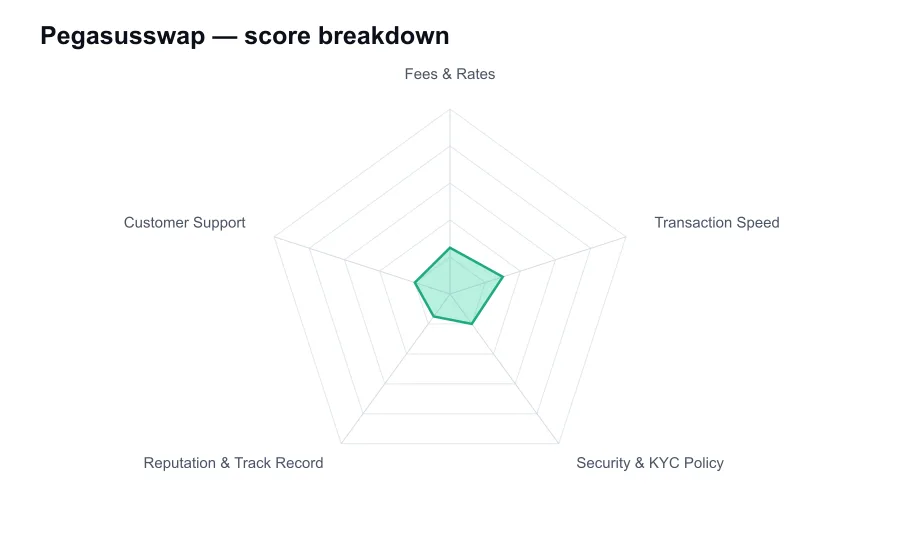
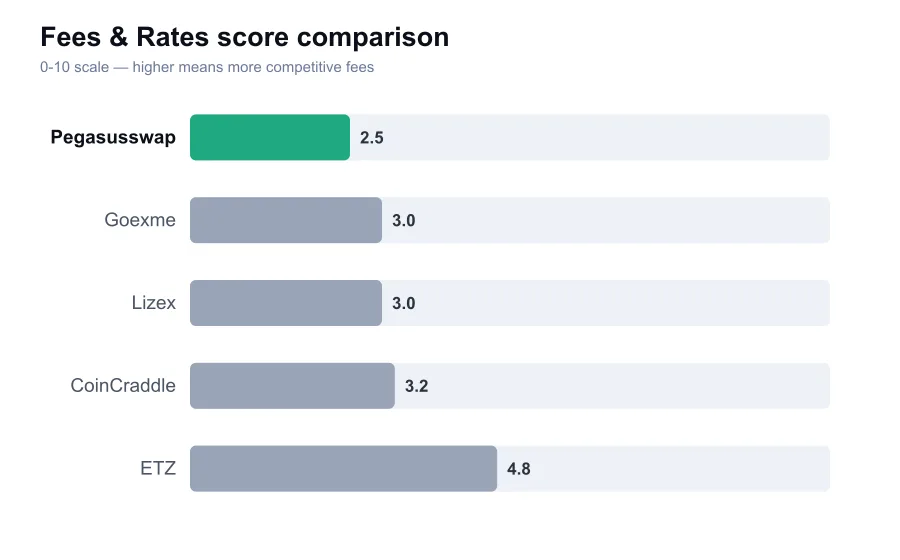
Fee transparency is weak. With an instant exchanger, the quoted output is the practical price, but customers should still be able to understand whether a visible service fee, network charge, and market spread are involved. Pegasusswap does not have a well established public pricing record or a recognized independent history of quote comparisons. That makes it impossible to say whether its rates are consistently fair.
A low-looking rate can be misleading if a quote is floating and the provider has a long processing window. If the input asset moves after the deposit arrives, the output may differ from what the user expected. A reputable service explains its rate lock rules, deposit deadlines, and what happens if a customer sends too little, too much, or uses the wrong network. I could not verify sufficiently detailed public handling rules here.
Speed should be viewed with the same skepticism. A website might promise a rapid conversion, but the actual path includes deposit confirmation, risk screening, liquidity sourcing, trade execution, and payout broadcasting. Any one of those stages can create a delay. Without a substantial body of reliable customer reports, there is little reason to assume Pegasusswap will perform consistently under pressure.
The worst case is not simply waiting an extra hour. The real concern is a deposit that enters a review state while the customer cannot get a useful answer about timing, documentation, or refund eligibility. This is why clear support and terms matter more than slick design. Pegasusswap does not offer enough publicly verifiable assurance on that front.
Security is also about accountability. An instant exchanger temporarily controls customer deposits, which makes its operational controls, legal identity, and communications process relevant. Pegasusswap lacks the visible company, licensing, audit, or incident-reporting trail that would justify a strong security score. It may use standard web security, but web encryption alone says nothing about whether customer assets are handled well.
I would assume that any no-registration or low-friction setup remains subject to transaction review. Small exchangers sometimes advertise privacy-friendly access while retaining broad discretion to request information. If that happens after funds are sent, the user has limited leverage. Never use an obscure exchange if you need absolute certainty about KYC treatment or settlement timing.
Reputation is Pegasusswap's biggest failure. It is not widely recognized by the major crypto press, established market-data sources, or broad independent review communities in the way that mature providers are. There is no deep pool of evidence from which to determine how the business behaves during disputes. For a service handling money, that absence is a serious negative.
Support gets a low score for the same reason. I cannot point to a strong public record of responsive case management, detailed knowledge-base material, or transparent support escalation. A contact form is not the same thing as dependable customer service. If a provider is not easy to evaluate before you pay, it is rarely a good bet during an urgent recovery issue.
Experienced users sometimes argue that every provider was unknown once. That is true, but it is not a reason to subsidize an unknown operator with a large deposit. New services can earn trust by publishing their company information, terms, fee methodology, security approach, and support standards. Until then, cautious users should test only tiny amounts, if they use them at all.
Pegasusswap also has no compelling differentiator that offsets its trust gap. It is not a clearly documented decentralized protocol, a major liquidity aggregator, a specialist regulated fiat provider, or an API platform with a proven business customer base. It is another centralized conversion intermediary competing against firms with much more evidence behind them.
For users seeking a simple swap, there are established alternatives with longer transaction histories and more transparent policies. For users seeking privacy, self-custody and decentralized protocols can reduce some counterparty exposure, though they introduce different technical risks. Pegasusswap falls awkwardly between those choices, offering convenience without enough proof of reliability.
My verdict is cautious to the point of rejection for meaningful funds. Pegasusswap may be functional, but there is insufficient verifiable information to recommend it against better documented instant exchange services. If curiosity wins, make the test amount trivial and preserve every record. Everyone else should choose a provider that has earned a reputation rather than asking customers to supply one.