Goexme is far less established in public view than the other providers in this comparison. That matters. In crypto, a polished swap form and an attractive rate do not amount to a track record. A user considering a lesser-known exchange service has to ask harder questions about who operates it, how long it has processed customer funds, which liquidity partners it uses, and whether there is meaningful evidence of resolved problems.
The available public footprint for Goexme is thin enough that I would not assign it the benefit of the doubt. I could not verify a reliable official domain, an independently documented company history, a detailed fee schedule, or durable evidence of active customer operations from authoritative sources. That is not proof of misconduct. It is, however, a practical reason to be cautious.
Some reviewers make the mistake of treating lack of bad news as good reputation. It isn't. Major exchanges and long-running instant swap providers leave a trail: product updates, archived documentation, public support records, corporate registrations, partner announcements, user feedback across several years, and often coverage from industry publications. Goexme does not appear to have that level of independently verifiable history.
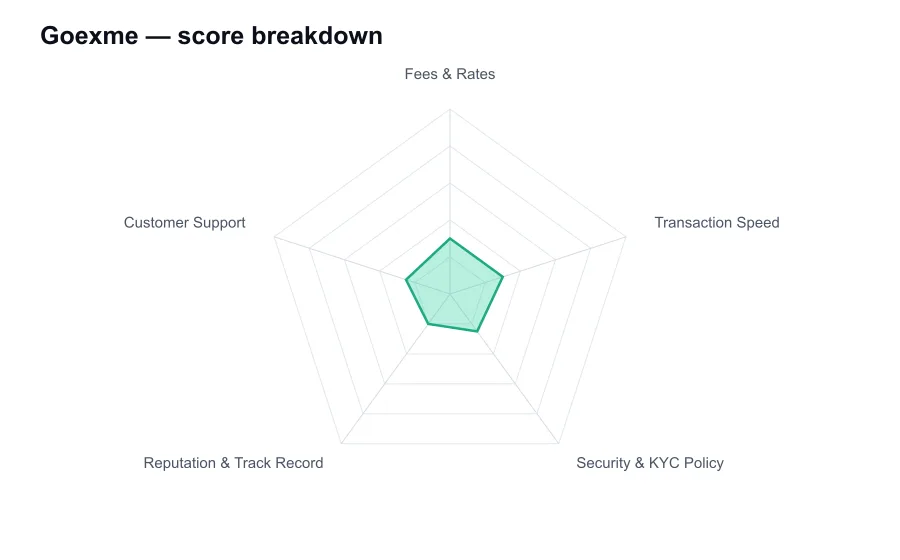
That missing history directly affects the reputation score. A new provider can be competent, and a small operator can offer excellent support. But a reader cannot responsibly infer either point without evidence. Crypto users should not become the first serious test of a service's operational controls simply because it advertises a favorable conversion rate.
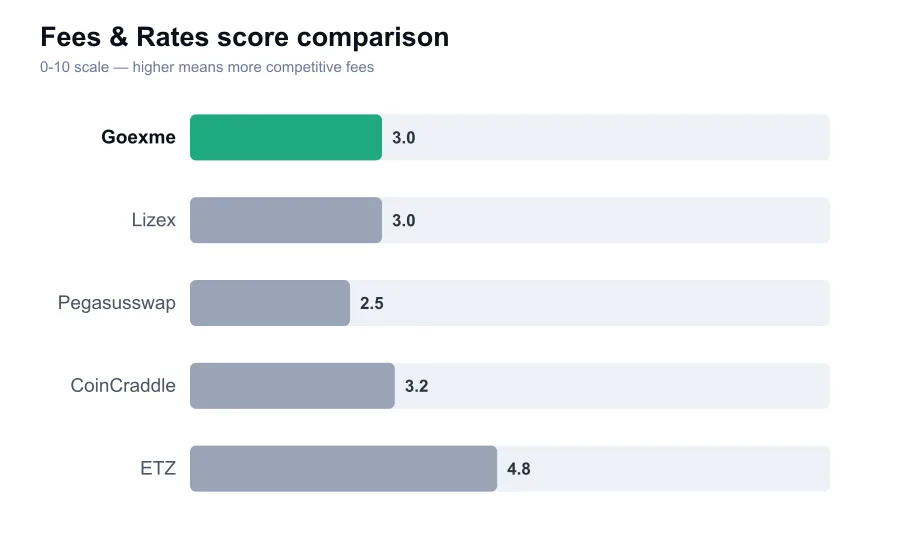
Fees are impossible to evaluate confidently without a current, authoritative fee page and repeatable live quotes. An instant exchanger can advertise no fee, a tiny fee, or a fixed commission while earning through spread. There is nothing inherently wrong with a spread if the quote is clear, but opaque pricing is a poor fit for users who need to know their execution cost before sending irreversible funds.
If Goexme presents a quote, compare the exact output with a liquid spot-market route and at least two established instant exchangers. Do not compare only the input amount or a percentage shown on the page. Check whether the quoted payout already includes network charges, whether the rate is fixed or floating, and whether a minimum deposit means small transactions become uneconomic.
Speed cannot be separated from operational proof either. Any website can claim fast swaps. Real speed means timely deposit detection, sensible confirmation requirements, reliable access to liquidity, rapid payout signing, and competent intervention if a transaction gets stuck. Without a body of reliable transaction reports and technical documentation, I would regard any speed promise as unverified marketing rather than a demonstrated advantage.
Security is the bigger concern. An instant exchange holds a user's incoming funds for at least part of the settlement process. The service may call itself non-custodial because it does not maintain a persistent user balance, but the customer still trusts it to receive the deposit, source the output asset, and send that output to the correct address. That is a meaningful custodial moment.
For a provider with limited public information, users should expect to see basic security disclosures before risking funds. Those include a clear legal operator, terms that explain held or rejected deposits, a privacy policy, supported-network rules, responsive official support channels, and a way to verify the authentic domain. I could not establish enough of those details to recommend Goexme confidently.
KYC policy is also not something to assume from silence. A service may permit a swap without asking for ID at the start, then require a review after funds arrive if its compliance tools flag the transaction. That can be legitimate, but the policy should be documented plainly. Users should not rely on claims of anonymity unless they can read the actual terms and understand the exceptions.
Support deserves a low score here because it is not possible to judge a support team from promises alone. The useful test is whether a person can get a documented response when a deposit is delayed, a memo is missing, or an order needs a refund. With an unfamiliar provider, test support before sending money. Ask a specific pre-sale question and assess whether the response is competent and traceable.
There is a temptation to use a little-known exchange for a token pair that larger providers do not support. That is exactly where caution should increase. Obscure tokens carry contract-address risk, shallow liquidity, and confusing network variations. A weak operator can hide a poor rate behind a pair that is hard to price. The more unusual the asset, the more important reputable custody and transparent execution become.
I would not tell readers that Goexme is fraudulent based solely on the lack of verifiable information. That would be irresponsible. I can say that it does not meet the evidence standard I would want before recommending a financial service to a general audience. The burden is on the provider to show why users should trust it, not on users to prove why they should be wary.
My recommendation is simple: avoid sending meaningful funds to Goexme until you can independently verify its official identity, current operating status, terms, fees, support responsiveness, and successful recent use from credible sources. If you insist on testing it, use the smallest viable amount and a wallet you control. Established alternatives may cost a little more, but a modest spread is cheaper than an unrecoverable deposit.